AI Face Analysis: Symmetry, Ratios, Shape, Age, Harmony
EXAMPLE ANALYSIS: 478 LANDMARKS MAPPED ON A SAMPLE PHOTO, NOT YOURS.
What a reading looks like
Real components · sample dataA starting line, not a verdict.
What we won't show you: a confidence band (not until our test-retest study ships) · a percentile (not until a reference population is published) · a skin score from one photo (lighting lies). Every "not scored" comes with its reason.
A complete AI face analysis measures seven things: symmetry, proportions, harmony, averageness, sexual dimorphism, youthfulness and skin quality. Every measurement here runs on your device: photos never leave your browser, and nothing uploads.
It also names the parts of that list your own photo could not support, before you scroll past them.
The Short Version
What Does a Face Analysis Measure?
A complete face analysis measures symmetry, proportions, harmony, averageness, sexual dimorphism, youthfulness and skin quality. This scan reports nine of those as individual values, because proportions alone splits into four separate numbers.
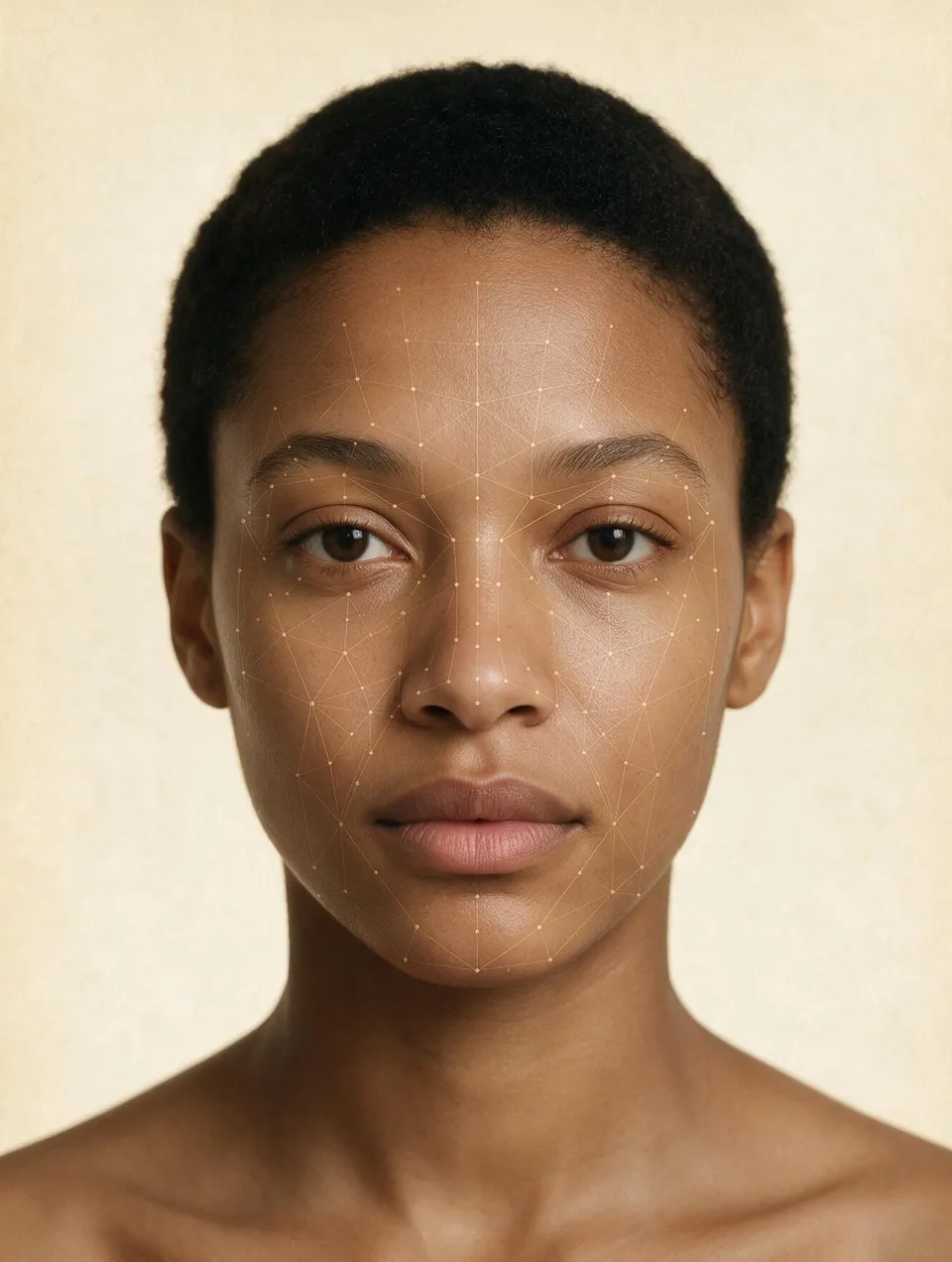
Every number on this page starts as a map like this one: landmark points fitted to a single photograph and joined into a mesh. A distance between two points becomes a ratio, an angle, or a percentage. The scan fits 478 of these points inside your browser, and each metric reads from the same map, which is why the numbers move together rather than independently.
Nine rows below come back with a value and a unit. Five more are named without a value: some because a single front photo cannot support them, one because the number belongs to a different instrument entirely. Every row states which case applies, and links to the page that measures it in full where one exists.
| Metric | What it is | Unit reported | Where it is explained |
|---|---|---|---|
| Symmetry | Left-right landmark agreement across a fitted midline | Mean absolute landmark deviation as a percent of interpupillary distance | face symmetry test |
| Facial thirds | Forehead, midface and lower-face height, compared | Ratio of upper to middle to lower vertical segments, normalized to 1.00 | Measured above, explained in full at the golden ratio page below |
| Facial fifths | Face width divided into five eye-width columns | Each fifth as a proportion of bizygomatic width | Measured above, explained in full at the golden ratio page below |
| Facial width-to-height ratio | Face width compared with upper-face height | Bizygomatic width divided by upper-face height, to two decimals | Measured above, explained in full at the golden ratio page below |
| Golden-ratio conformity | Measured ratios compared with 1.618 | Absolute difference from 1.618, per ratio pair, never a phi score out of 100 | golden ratio face |
| Canthal tilt | The angle of the eye's outer corner relative to the inner corner | Degrees from horizontal, signed, with the roll correction shown | canthal tilt |
| Facial harmony | Agreement between the components above | Spread of the component z-scores, labeled as a derived quantity, not a measurement | facial harmony test |
| Face shape | Outline classification | A class label plus the margin to the next-nearest class, for example oval, margin 0.11 over oblong | face shape detector |
| Apparent age | How old the geometry and skin cues read, not your actual age | A range in years, never a single point | how old do i look |
| Attractiveness Score | Not computed here | No value. The full 1-10 score is a separate instrument with its own reference population | how attractive am I, the namesake test |
| Averageness | Not scored in this scan | No value. Needs a reference population, not a better photo | Reported on the site's flagship instrument |
| Sexual dimorphism | Not scored in this scan | No value. Same reason as averageness | Reported on the site's flagship instrument |
| Skin quality | Not scored in v1 | No value. A compressed photo under unknown lighting cannot support a colour or texture reading | Planned as a dedicated guide |
| Nose projection, profile angles, 3D volume | Not scorable from a front photograph | No value. Geometry, not effort, is the limit | Planned as a dedicated side-profile tool |
The geometric measurements: symmetry, proportions and harmony
The geometric measurements come from distances between landmarks, expressed as a percentage, a ratio, or a difference from a fixed value. Symmetry compares paired points across a fitted midline. Thirds, fifths, facial width-to-height ratio and golden-ratio conformity each divide one distance by another. Harmony then measures how far those numbers spread from each other. Together they contribute six individual measurements to the manifest above.
The descriptive measurements: face shape, the eye region and the jawline
The descriptive measurements come back as a class or an angle rather than a ratio, and that distinction changes what confidence looks like. Face shape returns a class with a margin to the next-nearest class, so a face called oval by a narrow margin is a different claim than one called oval decisively. Canthal tilt, the eye region's angle, returns a sign and a roll correction rather than a class. A jawline reading works the same way, as its own angle at the corner of the jaw. This scan reports face shape and canthal tilt directly; a jawline reading runs on its own jawline rating page, built on the identical landmark set.
What a single front photo cannot measure
A single front photograph cannot support five things this analysis would otherwise report, each for a reason rooted in geometry rather than in effort. None of these improves with a better photo of the same kind.
- Projection and profile angles, which need a second view from the side.
- Three-dimensional volume, which a flat image cannot recover.
- Skin colour and texture, distorted by compression, lighting and makeup rather than by modesty.
- Anything about a face in motion, since one frame is one instant.
- Averageness and sexual dimorphism, which need a reference population rather than a better photograph.
A dedicated side-profile scan and a skin-quality guide are both planned additions to this list. Until either ships, both rows stay named rather than guessed at.
How the 478-Landmark Mesh Works
One face mesh does all the work behind every number on this page. The scan fits 478 points to your photograph inside your browser, and every component reads from that same map rather than from separate photographs. Each result then checks itself against its own tolerance before it renders, which is why some rows carry a value and others carry a named reason instead. The number shown here and the number its own dedicated tool returns are the same number, for the same photo and the same version. If they ever differ, that is a measurement error on our side, not a rounding choice.
- Fit 478 landmarks to your photograph inside your browser, with no image ever leaving the device.
- Read each metric from the points that measurement needs, using one mesh for all of them.
- Check each result against its own published tolerance before it renders.
- Render the manifest with every metric that passed, and name the reason beside every one that did not.
What each measurement needs from your photo
Different measurements survive different photographs. The table states, for each metric this scan can report, how far your head can turn before the number stops meaning anything.
| Metric | Head-turn tolerance | What voids it | If it fails |
|---|---|---|---|
| Symmetry residual | Yaw 2 degrees, pitch 5 degrees | Directional lighting on one side, an asymmetric expression, hair or glasses crossing a measured pair | Not measured: a turn always understates symmetry |
| Facial thirds and fifths | Yaw 5 degrees, pitch 5 degrees | Hairline covered (the forehead landmark is not the hairline) | Not measured: forehead not visible |
| Facial width-to-height ratio | Yaw 5 degrees, pitch 5 degrees | Cheek outline covered | Not measured: jaw or cheek outline unclear |
| Golden-ratio conformity | Yaw 5 degrees, pitch 5 degrees | Same conditions as thirds and fifths | Same as thirds and fifths |
| Canthal tilt | Yaw 8 degrees, pitch 5 degrees | Roll over 3 degrees after correction, glasses rims crossing a corner, squinting | Not measured: eye corners unclear |
| Facial harmony | Inherits the strictest gate of its own inputs | Any input metric refused | Not measured: an input was refused |
| Face-shape class | Yaw 15 degrees, pitch 10 degrees | Hair covering the jaw or temple outline | Not measured: outline unclear |
| Jawline, gonial angle | Yaw 8 degrees, pitch 5 degrees | A beard covering the mandibular border | Not measured: jaw border unclear |
| Apparent age | Not sensitive to pose; sensitive to resolution | Heavy filtering, low resolution, strong makeup | Not measured: resolution too low |
The tightest tolerance on the page belongs to symmetry, at 2 degrees of yaw, matched to the strictest published limit found in this category rather than set past it. Face-shape class survives fifteen. That gap is the whole argument for gating each metric on its own terms instead of passing or failing an entire scan on one number.
Why One Scan Gives Nine Numbers and Not Nine Verdicts
These nine measurements come from one mesh, so they move together rather than independently. Turn the head two degrees and several numbers shift at once, because they share the same landmark points and the same fitted midline. A composite built from correlated numbers is a weighted sum, not a fact discovered in the data: the weights are a choice, and a different choice produces a different total from the identical photograph. Two tools that both print an overall score in the eighties are not measuring the same thing unless both publish the weights behind that total, and outside this site, none do. The research agrees with that structure. Symmetry, averageness and sexual dimorphism each carry a small share of rated attractiveness rather than one of them carrying most of it [2][8]. A single blended number would therefore hide the one fact worth keeping: the components disagree with each other more than a total lets on. This page prints no single face-analysis number, because a number like that would be our opinion of the weights, not a measurement of your face.
What Do I Look Like to Other People?
The gap between a mirror and a photograph comes from two sources: how much people agree about a face, and how much comes down to individual taste. A landmark measurement reports geometry, not anyone's opinion of you.
Raters agree with each other about facial attractiveness more than beauty is subjective implies, and less than a single number implies. Within one culture, agreement between raters runs high, and substantial agreement holds across cultures too [2]. That still leaves room for you: private taste accounts for close to half the variance in ratings of the identical face [3]. Agreement between cultural groups is real but consistently weaker than agreement within a group, and it leans on different cues depending on which group is rating [4]. Put together, what other people see is neither a fixed fact about your face nor pure guesswork on their part; it is a shared component and a private one, roughly split. A landmark measurement like the ones on this page describes geometry. It does not poll anyone's opinion, and it cannot report what a specific person thinks of you.
What the Evidence Says About Face Measurement and Attractiveness
Four claims bound what this page asserts, strongest evidence first, each stated as a claim, a named study, an effect size, and what the finding does not license.
Raters agree with each other more than beauty is subjective suggests. Langlois and colleagues, in a meta-analytic review in Psychological Bulletin in 2000, found within-culture agreement running around r = 0.90, with substantial agreement holding across cultures too [2]. That does not license one number as a fact about a face. Hönekopp, in the Journal of Experimental Psychology in 2006, found private taste accounts for close to half the variance in the same ratings [3]. Coetzee and colleagues, in PLoS ONE in 2014, found cross-cultural agreement real but weaker between groups than within them [4].
Symmetry, averageness and sexual dimorphism each predict rated attractiveness, and each predicts a small share of it. Rhodes, reviewing the field in the Annual Review of Psychology in 2006, reports all three as reliable but modest predictors [1]. Van Dongen, in Annals of Human Biology in 2011, found the symmetry association carries signatures of publication bias, meaning the true effect sits smaller than the published average [6]. Scott and colleagues, in PNAS in 2014, found dimorphism preferences shift by rater and by task rather than pointing in one direction [7]. Grammer and Thornhill measured the direct association in 1994 [5].
The golden-ratio mask claim is not supported. Holland, in Aesthetic Plastic Surgery in 2008, found the phi mask fits fashion models rather than the general population [9]. Pallett, Link and Lee, in Vision Research in 2010, found the ratios people rate as optimal sit near population averages, not at 1.618 [10]. Neither study licenses phi as a rule of beauty; both bound the claim to a narrow one.
The health-signal story is weaker than the category's marketing. Foo and colleagues, in Scientific Reports in 2017, found facial cues predict rated attractiveness far more reliably than they predict measured health [8].
Face Analysis, Facial Analysis and Face Scanners: Four Things That Share One Name
Four different things are called facial analysis, and this page performs exactly one of them: measuring facial geometry from a photograph.
| What it is called | What it actually is | Who it is for | Where to go |
|---|---|---|---|
| Consumer AI face measurement | An on-device landmark scan reporting geometry, not a verdict | Anyone who wants numbers from a photograph | Right here, on this page |
| Clinical or orthognathic facial analysis | A surgeon's or orthodontist's structural assessment | Someone considering a procedure or a structural diagnosis | A qualified clinician, in person, never a photo tool |
| Skin-analysis imaging | A different instrument on different hardware, reading colour and texture under controlled lighting | Someone asking about a skin condition | A skin-analysis device or a dermatologist |
| Face-recognition ability tests | A test of a system's or a person's ability to identify faces | Researchers studying or building recognition systems | Not this page. This instrument identifies nobody |
Four industries kept the same two words, and none of them called first to ask. If a search engine sent you here for one of the other three, the row above is the correction, not an apology.
What This Analysis Does Not Infer: Personality, Ancestry, Health, Intelligence
This analysis measures geometry from a photograph, and geometry cannot support six things people sometimes search a face analyzer to learn. Each one is refused for a stated reason, not as a policy footnote.
- Personality or character: a face reading is not a measurement, whatever the video calls itself.
- Ancestry or ethnicity: the reason is bias in how these systems get built, not difficulty.
- Health or any medical status: a landmark mesh reads position, not tissue.
- Intelligence: no landmark correlates with it, and none is claimed to.
- Sexual orientation: not a geometric property of a face.
- Potential, including model potential: a projection this scan has no data to support.
What This Score Cannot Tell You
This returns measurements rather than a score, and measurements have their own limits. Six of them are named below.
The complete construction, every reference population and every failure mode live on how we measure, and where the measurement fails.
If thinking about your face has stopped feeling like curiosity, the National Alliance for Eating Disorders helpline is free and answered by clinicians.
The measurement's account of your face is complete. What follows is about the list of numbers you now have: which of them carry weight, and what to do with the rest.
You Have Every Metric Now: Which Ones Actually Moved Your Score?
A manifest is only useful once you know which rows carry weight and which are noise. The next three sections translate your numbers into the site's scale, tell you how to check a result before trusting it, and rank what actually moves these measurements against what only sounds like it should.
Where these numbers sit on the 1-10 scale
Each metric above describes where your photograph sits on that metric's own scale: a percentage for symmetry, a ratio for proportions, a spread for harmony. The site's 1-10 scale is a separate vocabulary that translates a full set of measurements into one interpretive band, and it is built and explained on its own page rather than repeated here. See what a 1-10 attractiveness score really means for the band definitions your numbers eventually feed. A metric printed here in its own unit and a band printed there in the 1-10 vocabulary answer two different questions about the same photograph.
How to check a scan before you believe it
- Hold your phone's rear camera at arm's length, not the front camera close to your face.
- Position the lens at eye height, facing you directly.
- Light your face evenly from the front, and keep your expression neutral.
- Compare the new unit values against the old ones, metric by metric, rather than comparing band labels.
A difference smaller than the tolerance published in the table above is noise, not a change; a difference larger than it is worth a second retake before you trust either result.
What actually changes them
Camera distance, lighting direction and head position move these numbers immediately, and they change nothing about your face while doing it [11]. Grooming, styling, sleep and hydration move some measurements modestly over days and weeks, mostly through what the mesh reads at the hairline, brow and jaw outline. The claims that do not survive contact with the tolerance table above, mewing, jaw exercises and bone-smashing among them, are named once here and not argued again. None of them move an adult skull, so none of them move a landmark this scan reads.
This free scan measured nine of your metrics and named five it could not score. Your Attractiveness Report measures 40+ points including the ones marked not scored here, ranks which measurements moved your overall score, and gives you a 30-Day Re-Score against the same formula version.
Is an AI Face Analyzer Accurate?
This analyzer is accurate in the reproducible sense: the same photograph and the same software version return the same measurement every time, which is a narrower claim than being right about your face.
Reproducibility is the claim this page defends, and the per-metric tolerance table above is part of that defense rather than an apology for it. A metric only renders once its own photograph conditions are met, so a number that does appear has already passed a named check. No validated accuracy percentage exists for this analyzer, or for any consumer face analyzer, because no study has measured one against a criterion strong enough to publish. Printing one anyway would be the easiest fabrication available on this page. The honest comparison is not a bigger number. It is a published unit, a published tolerance and a stated limit, on a page most face analyzers ship without any of the three. The full method, every reference population and the version history live on the methodology page linked above.
Free AI Face Analyzers: What to Ask of Any of Them
Five questions separate a measurement from a number with a shrug attached, and you can run all five against any face analyzer, including this one.
- The unit behind every number, not just the number itself.
- Whether your photo runs on your device or leaves it.
- Whether it refuses a photo it cannot measure, instead of guessing.
- Whether it names what it did not measure, row by row.
- Whether it is one payment or a recurring one.
Every free tool in the Attractiveness Report passes this checklist, which is a stronger claim than most of the category can make, and the reason it goes unstated above.
You have every measurement this free scan could take, and the citations behind them. Your Attractiveness Report ranks every one this scan named as not scored, in the order worth working on, and re-scores you on day 30.
Thirteen numbered citations below are peer-reviewed and indexed in PubMed. Every effect size named above was read from the source paper, not from a summary.
Not medical advice. This is a measurement of a photo, not a diagnosis, a clinical assessment, or a verdict on you.
It measures geometry, not worth. The number tells you where you start. It never tells you what you are.
on every page
of this site
Your report, in full.
- Side profile
- Skin, measured properly
- Averageness
- Dimorphism
- Ranked plan
Paid photo deleted within 24 hours · never used for training
- 40+ measurements, 7 regionsPP. 2-9
- Side profile, from a second photoPP. 10-13
- What moved your score, rankedPP. 14-16
- Four week plan and day 30 re-scanPP. 17-20
Frequently Asked Questions
What does facial analysis mean?
Facial analysis means measuring facial geometry from a photograph: landmark positions turned into distances, ratios, angles and classes. The same two words also describe a clinician's structural assessment and a skin-imaging scan, which are different instruments entirely.
Is there an app that analyzes your face?
Many apps analyze a face, and this one runs in a browser with no install and no account required. The question worth asking any of them is what unit each number is reported in.
Is there a free AI face analyzer available?
Yes, this analysis is free, complete and unmetered, with nothing gated behind an email address. The paid Attractiveness Report adds the measurements this free scan could not score, ranked by which ones moved the result.
What is the best free AI face analyzer?
The best free AI face analyzer publishes the unit behind every number, runs on your device instead of uploading your photo, refuses a photo it cannot measure, names what it did not measure, and charges once instead of a subscription. This page answers all five, and checking that yourself takes about two minutes.
Can ChatGPT analyze my face shape?
A general chat model can describe a photograph in words, but it does not measure one: no landmarks, no published unit, and no repeatable result between two runs of the same image. A dedicated comparison of chat-model output against a landmark measurement is covered elsewhere on this site.
Whose face is the most analysed, and can you analyse a celebrity's?
This analysis does not measure, estimate or publish the facial geometry of any named person, living or dead. Anyone can run their own photograph through the same scan, in a browser that sends it nowhere.
What is the best free AI skin analysis tool?
This scan does not score skin, because a compressed photograph under unknown lighting cannot support a colour or texture measurement. Skin-analysis imaging uses different hardware under controlled lighting, and any concern about a skin condition belongs with a clinician, not a photo tool.
Where does my photo go when I run a full face analysis?
The mesh, every metric and the overlay are produced inside your browser, and no image, landmark coordinate or derived value is transmitted while you run the scan. Sharing a result requires two separate opt-ins, and the complete account of what is and is not transmitted is on the site's privacy page.
References
Every claim above, traceable
- Rhodes G, Annual Review of Psychology 2006 - The evolutionary psychology of facial beauty: symmetry, averageness and sexual dimorphism are reliable but modest predictors of rated attractiveness.
- Langlois JH, Kalakanis L, Rubenstein AJ, Larson A, Hallam M, Smoot M, Psychological Bulletin 2000 - meta-analytic review: raters agree on facial attractiveness at about r = 0.90 within cultures, and agreement holds across cultures.
- Hönekopp J, Journal of Experimental Psychology: Human Perception and Performance 2006 - private taste accounts for roughly half the variance in facial attractiveness ratings of the same faces.
- Coetzee V, Greeff JM, Stephen ID, Perrett DI, PLoS One 2014 - cross-cultural agreement in facial attractiveness preferences is real but weaker between ethnic groups than within them.
- Grammer K, Thornhill R, Journal of Comparative Psychology 1994 - human facial attractiveness and sexual selection: symmetry and averageness both relate to rated attractiveness.
- Van Dongen S, Annals of Human Biology 2011 - associations between asymmetry and human attractiveness carry signatures of publication bias, meaning the true effect is smaller than published averages.
- Scott IM, et al., Proceedings of the National Academy of Sciences 2014 - preferences for sexually dimorphic faces vary by rater and by task rather than pointing in one consistent direction.
- Foo YZ, Simmons LW, Rhodes G, Scientific Reports 2017 - facial cues predict rated attractiveness far more reliably than they predict measured health.
- Holland E, Aesthetic Plastic Surgery 2008 - Marquardt's phi mask fits fashion models rather than the general population, undermining the golden ratio as a beauty rule.
- Pallett PM, Link S, Lee K, Vision Research 2010 - the facial ratios people rate as optimal sit close to population averages, not at 1.618.
- Ward B, et al., JAMA Facial Plastic Surgery 2018 - short-distance photographs distort facial proportions, the selfie effect, independent of the face itself.
- Samson N, Fink B, Matts PJ, International Journal of Cosmetic Science 2010 - visible skin condition affects perception of facial appearance, and a compressed photo under unknown lighting cannot reliably measure it.
- Geniole SN, et al., PLoS One 2015 - meta-analysis of the facial width-to-height ratio finds its popular interpretation weaker than its popular reputation.