AI Face Symmetry Test: Symmetry and Asymmetry, Measured
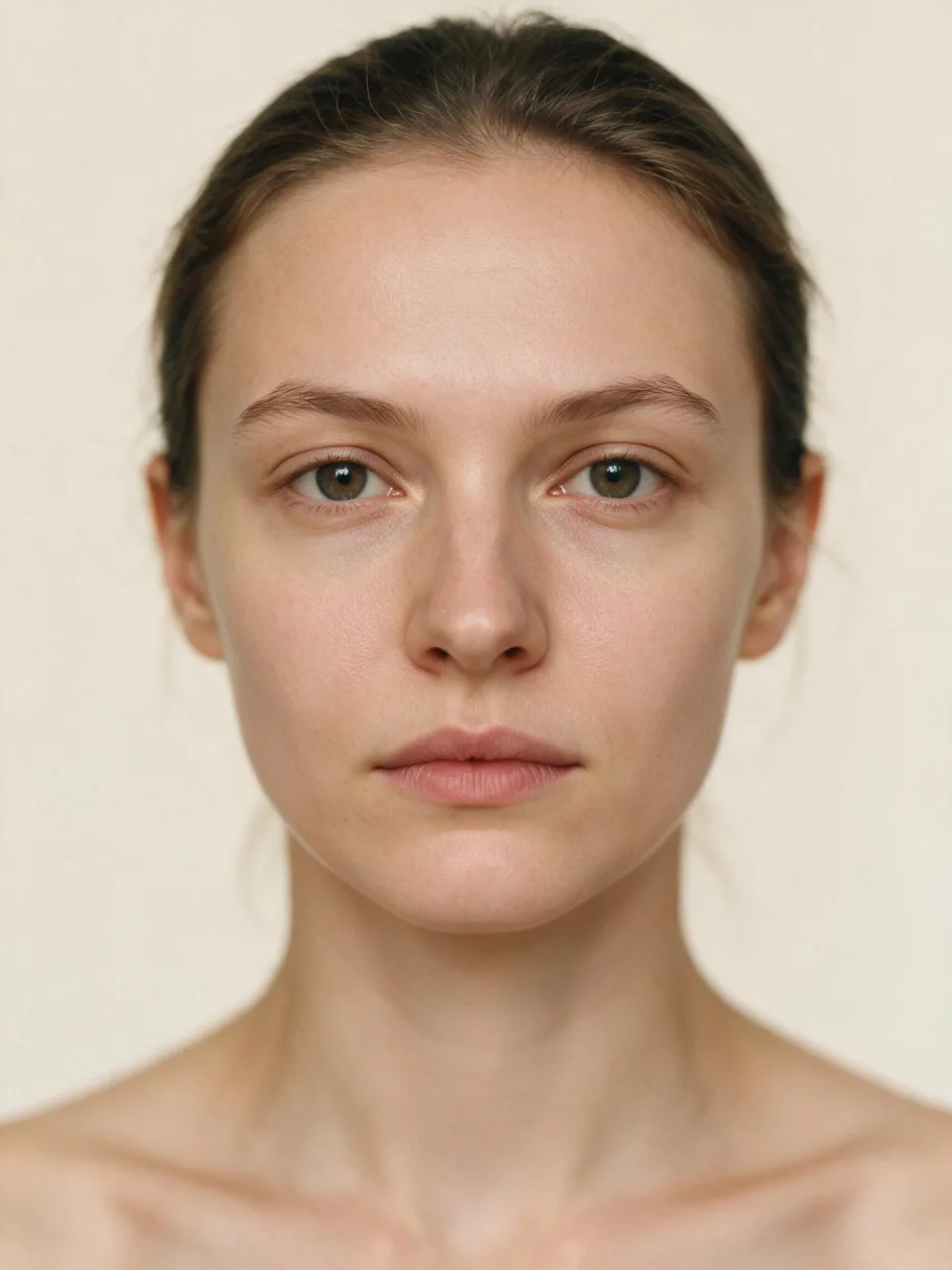
EXAMPLE ANALYSIS: 478 LANDMARKS MAPPED ON A SAMPLE PHOTO, NOT YOURS.
What a reading looks like
Real components · sample dataA starting line, not a verdict.
What we won't show you: a confidence band (not until our test-retest study ships) · a percentile (not until a reference population is published) · a skin score from one photo (lighting lies). Every "not scored" comes with its reason.
Symmetry correlates with rated attractiveness, but weakly to moderately; mild asymmetry is the population norm. This AI facial analysis mirrors your paired landmarks across a fitted midline, on your device, returning a deviation figure beside a 0 to 100 score.
The Short Version
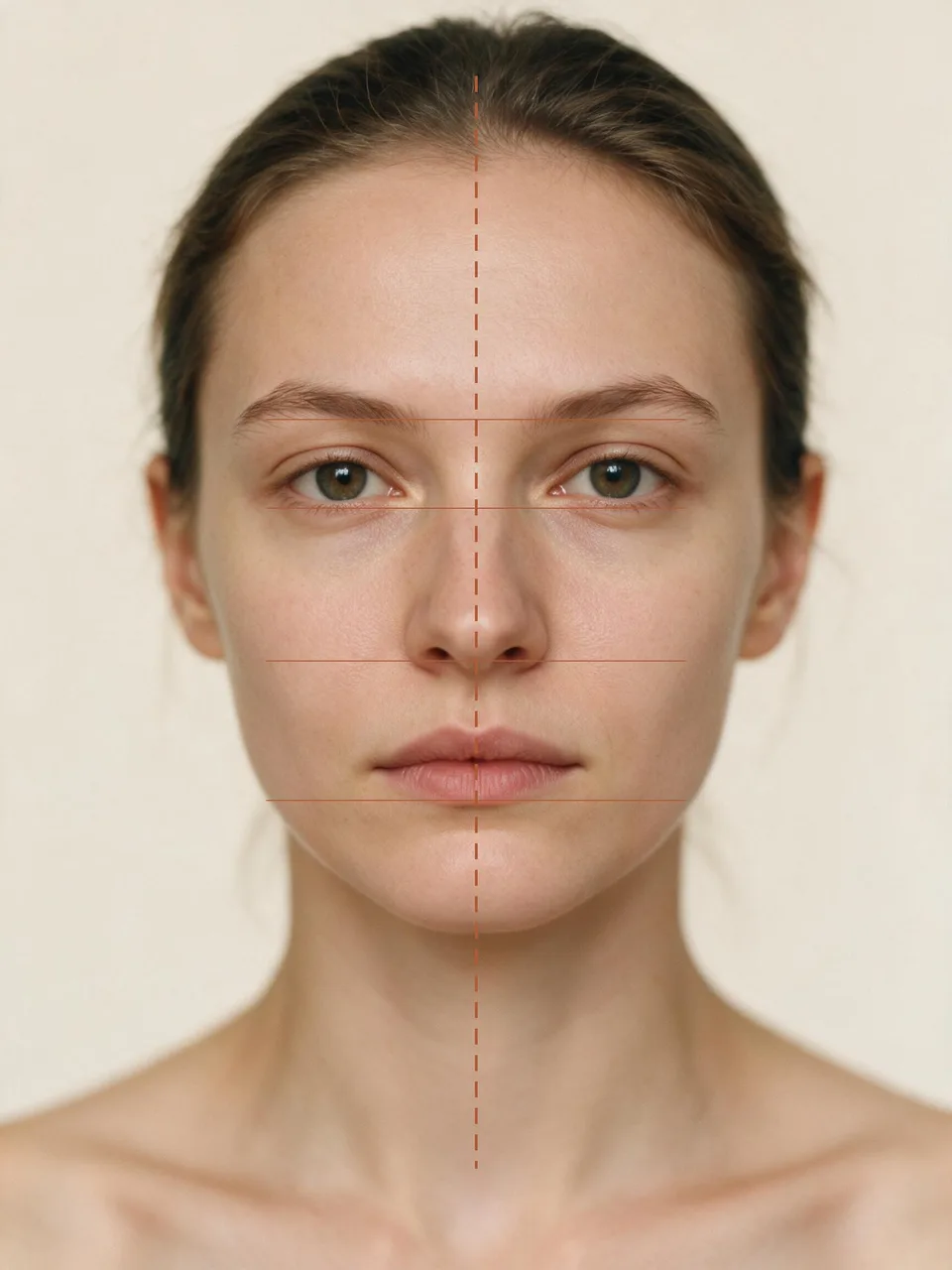
Symmetry is measured across a midline fitted to your own face, not an assumed vertical. That single choice is what keeps a tilted head from reading as an asymmetric face: the axis tilts with you, and only genuine left-right differences count against the score.
How Do I Test My Face Symmetry?
You test your face symmetry by comparing matching landmarks on each side of a straight-on photo against a vertical midline, using either a landmark tool or a printed photo and a ruler.
This test runs that comparison automatically. A 478-point mesh fits a midline through five stable facial anchors, mirrors twelve bilateral landmark pairs across it, and measures each pair's residual, entirely on your device: photos never leave your browser.
- Photograph your face straight-on at eye level with your phone's rear camera, in even light, with a relaxed expression.
- Draw a vertical line from the bridge of your nose through the center of your chin.
- Mark the same paired points on each side of that line, such as the pupils, the eye corners or the mouth corners.
- Compare the two distances from the line rather than eyeballing the halves, since the eye rounds small differences to zero.
A phone and a straight edge get you most of the way there. This tool runs the same comparison faster, with a fitted midline instead of a hand-drawn one.
What Is Facial Symmetry, and What Is Asymmetry?
Facial symmetry is the correspondence of paired features across a facial midline; asymmetry is the measured deviation from that correspondence.
A facial midline runs from the forehead through the nose to the chin. Paired landmarks sit an equal distance from it on a fully symmetrical face: the two eye corners, the two mouth corners, the two sides of the jaw. Facial symmetry, a symmetrical face and left-right balance describe that same correspondence. Asymmetry is what remains after the comparison, the deviation between a landmark and its mirrored partner.
The question stays the same whichever word order is used. Symmetry vs asymmetry face, asymmetrical vs symmetrical face, asymmetry vs symmetry face and facial symmetry vs asymmetry all ask how much deviation separates the two halves.
Directional asymmetry: the difference almost every face has
Directional asymmetry is the consistent left-right difference most healthy faces carry, such as one side of the jaw sitting a little wider or one brow resting a fraction higher. Ercan and colleagues measured 321 young Turkish adults using statistical shape analysis and found this pattern is a population-level regularity, not random noise, with the left side dominant in both sexes. A face with this kind of difference is not asymmetrical in the sense the word implies online. It is ordinary.
Fluctuating asymmetry: the small random part research is about
Fluctuating asymmetry is the small, random deviation from perfect bilateral symmetry that developmental-stability research studies, separate from the consistent pattern above. Researchers separate the two by taking repeated measurements over time and across more than one dimension of the face; a single 2D photograph cannot reliably tell a directional difference from a random one on its own. This is the component the attractiveness literature actually studies, and it is small enough that one photo does not settle it.
How Your Symmetry Score Is Calculated, and in What Unit
This score comes from a midline fitted through five stable anchors: the glabella, the nasion, the nose tip, the subnasale and the menton. Every left landmark is mirrored across that line to its right-side partner, and the full two-dimensional residual between them, both the horizontal and vertical offset, is measured across twelve bilateral landmark pairs. The average of those residuals is normalized by your interpupillary distance, so the number stays proportional whether you stood close to the camera or far from it. Five feature groups, eyes, brows, nose, mouth and jaw, each carry a disclosed calibration weight, with jaw weighted heaviest and nose weighted lightest.
The result is one number with a stated denominator: mean absolute pair deviation, reported as a percentage of interpupillary distance. The 0 to 100 score is a published transform of that percentage, so a smaller deviation produces a higher score. This test works as a face symmetry checker, a facial symmetry calculator, a symmetry analyzer and a symmetry scanner, and it prints the same percentage behind every one of those names.
This is a two-dimensional estimate from a single photograph, computed on your device, not the three-dimensional scan used in clinical anthropometry, and the two units are never converted into each other on this page.
Is My Face Symmetrical? What's a Good Symmetry Score?
A good face symmetry score is a high one on this instrument's 0 to 100 scale, since a smaller deviation maps to a higher number. There is no universal 90, because no two symmetry tools share a unit.
Ninety percent symmetrical means nothing without knowing ninety percent of what, and most face symmetry tools never publish that denominator.
This test states its denominator on the result screen: mean deviation as a percentage of interpupillary distance, mapped to a 0 to 100 score by a transform published on /methodology. A 90 here describes a low measured deviation on this instrument's own scale. A 90 printed by a tool that has never disclosed its math could describe almost anything, because 'symmetrical' without a stated denominator is an adjective, not a measurement.
Whether your face is symmetrical, how symmetrical it is, and whether it counts as asymmetrical are the same question asked three ways: how large is the measured deviation, and where does that deviation's band sit. The band itself, and how it maps onto the site's score vocabulary, is set out further down this page.
How Rare Is Perfect Face Symmetry? What the Normal Ranges Are
Perfect face symmetry is rare: in a 3D photogrammetry study of 100 healthy adults, the average difference between the left and right sides was 0.80 millimeters, not zero.
There is no single normal symmetry value. There are measured distributions, and they differ by population, method and which facial structure was measured. The studies below report their findings in millimeters from 3D scans or as an index from 2D photographs, neither of which is this tool's percentage of interpupillary distance.
| Study | Population | n | Method | Reported asymmetry |
|---|---|---|---|---|
| Taylor et al. 2014 | US adults, mean age 34 (71% white, 11% Asian, 10% Black, 5% Hispanic, 3% other) | 100 | 3D stereophotogrammetry against a fitted plane of maximum symmetry | Mean surface deviation 0.80 ± 0.24 mm (median 0.77 mm) |
| Ercan et al. 2008 | Young adults, Turkey | 321 | 2D digital image analysis, Euclidean distance matrix | Left side dominant in both sexes; women significantly more asymmetric than men |
| Huang et al. 2013 | Young adults, China | 60 | Asymmetry index from 16 landmarks to the midsagittal plane | Left-right (horizontal) displacement was the component most easily detected by clinicians and patients |
Every row names its population and its sample size, because a number without either is the mistake this whole subject makes.
What the normal-range studies actually measured
The three studies above measured surface geometry on healthy volunteers with 3D scans or 2D photographs, not landmark deviation as a percentage of interpupillary distance, so none of them measured what this tool measures. Taylor's team scanned volunteers with no history of facial trauma or surgery. Ercan and Huang photographed young adults and compared paired points across a fitted or estimated midline. Their numbers answer one question, whether a given difference is ordinary, not whether a particular symmetry score is good. Converting millimeters into a percentage, or the reverse, is not done anywhere on this page.
Symmetry in men and women
Ercan and colleagues measured 150 men and 171 women and found women were significantly more asymmetric than men in this Turkish sample, with the left side of the face dominant in both. Taylor's more demographically mixed sample did not report a sex breakdown of its 0.80 mm average. Published research does not support one universal sex gap, and where a difference is measured, it is smaller than the difference between two people of the same sex.
What the Evidence Says About Symmetry and Attractiveness
Symmetry is one of the reliably replicated correlates of rated attractiveness, and its association is small. Van Dongen's meta-analysis of the visible-asymmetry literature found a correlation of r = 0.15 between measured asymmetry and rated attractiveness, with a 95% confidence interval of 0.07 to 0.23, and reported signatures of publication bias: larger studies produced smaller effects, a pattern selective publication predicts and a true effect that size would not.
Grammer and Thornhill's 1994 study established the paradigm most later symmetry-and-attractiveness research follows, and it found that both symmetry and averageness contributed to rated attractiveness in the same set of faces. Rhodes' 2006 review of the following decade placed symmetry among several correlates of facial attractiveness rather than above them, alongside averageness, sexual dimorphism and skin condition.
The 'symmetry signals health' story common on this topic has a documented limit. Pound and colleagues tested facial fluctuating asymmetry against measures of childhood illness in a large British birth cohort and found no association between the two, a null result that bounds how far the health-signaling claim travels from one small correlation.
The golden ratio is a separate claim about facial proportion, not symmetry, and its published support is weaker still. The golden ratio calculator, and what phi actually predicts, covers that claim on its own terms.
Can I Make My Face More Symmetrical?
You can't reliably make your face more symmetrical, and the strongest lever over your symmetry score is the photograph, not your face.
- How it photographs: camera distance, lens choice, lighting direction, head position and hair part all change a symmetry score immediately; one study found a face shot 12 inches away had a nasal base about 30% wider than the same face at 5 feet, distortion the tool did not put there.
- What has been tested and did not show it: a 20-week facial exercise program in 16 women aged 40 to 65 improved cheek fullness and perceived age, and did not measure facial symmetry at all, so it licenses no claim about evenness.
- The hard boundary: fillers, injections and corrective surgery are real procedures for real indications, named once and out of scope here, a question for a qualified clinician after an in-person exam.
Photography changes a symmetry score immediately. Facial exercises have not been shown to change facial symmetry. Structural change is a clinical question, not a routine, and facial symmetry exercises, graded by evidence, covers what the exercise claims actually rest on.
Symmetry Filters, Mirror Apps, and Face Symmetry Checkers
A mirror filter, an app-store symmetry checker and a landmark test with a disclosed unit aren't the same thing. This test ships both halves other tools split apart: the mirror-halves composite people are actually searching for, and the measurement with its unit printed beside it.
- Mirror or flip filter: builds a left-left or right-right composite from your photo and measures nothing.
- App-store symmetry checker: returns a score, usually with no stated unit and no way to check it.
- This test: builds the same composite and prints the deviation and unit it came from.
Ask any tool that prints a symmetry number one question before trusting it: a percentage of what. Most 'symmetry scores' online carry roughly the scientific backing of a fortune cookie, just with better lighting.
What This Score Cannot Tell You
The unit, the pair set and the band derivation sit on how we measure, and where the measurement fails.
How Does One Metric Feed Your Overall Attractiveness Score?
Symmetry is one component of an overall attractiveness score, and it is not the largest one. The full analysis also scores proportions, harmony, averageness and the eye region, and it weighs all of them together rather than letting one photograph's deviation figure stand in for the whole face.
The symmetry bands, 0 to 100
Your band describes where this photograph's measured deviation sits on this instrument's own 0 to 100 scale, from a wider deviation at the low end to a narrower one at the high end. It is a description of this instrument, not a population percentile.
The band explains what your score means on this instrument's own scale, published with its derivation on /methodology so it can be checked rather than taken on faith. It sits beside the site's separate 1-to-10 attractiveness vocabulary rather than inside it, since a 0-to-100 symmetry band and a 1-to-10 overall score answer different questions. What a 1-10 attractiveness score really means covers how that separate scale is built and interpreted.
How to confirm a score before you believe it
- Retake the photo with your rear camera at arm's length, lens at eye height and your face square to the lens.
- Match the lighting to the first photo, evenly lit from the front rather than from one side.
- Hold a neutral, relaxed expression, since a smile activates one side of the mouth more than the other.
- Compare the two deviation figures rather than the two band labels, since a band can round two close numbers into different words.
Compare the deviation figures, not the band labels. Three photos give a more honest spread than two, and when they disagree, the photograph is the variable, not your face.
What actually changes it
Camera distance, lighting direction and head position move a symmetry score, and the face underneath them mostly does not. Posture and jaw tension change how a difference reads to a viewer, without moving the measured geometry. Hair part covers or exposes the landmark pairs the score depends on. What the symmetry exercise evidence actually shows covers the exercise and massage claims graded above in full.
Is the Face Symmetry Test Accurate?
This test is reproducible: the same photograph and the same version return the same number, which is a narrower claim than being right about your face.
Three choices carry that claim. The result withholds a score entirely above 2 degrees of measured head yaw, matching the strictest published limit any tool on this topic discloses, rather than returning a number it would have to explain away. It reports the mean deviation beside the 0 to 100 score, so the number can be checked against any other measurement of the same photograph. And it prints no accuracy percentage, because no validation study against a clinical gold standard exists yet, while a competitor's marketing claim of over 95% accuracy currently sits inside a Google information panel with no study behind it. The method, the version and the test-retest data covers all three in full.
What Else Is Worth Measuring on a Face
Symmetry is one of several measurements on the same landmark mesh, and the full analysis scores all of them together rather than one at a time.
The full AI face analysis runs every component of the same mesh at once and scores them together instead of one metric at a time.
The full attractiveness test is the site's namesake instrument: the same 478 landmarks scored across five components into one result.
Proportions, harmony, canthal tilt and face shape are the other components of the same mesh, each answering a narrower question than an overall score can, without repeating what symmetry already covers here.
You have a deviation figure and the distributions behind it. The report ranks your own measurements in the order worth working on and re-scores them on day 30.
Not medical advice. This is a measurement of a photo, not a diagnosis, a clinical assessment, or a verdict on you.
It measures geometry, not worth. The number tells you where you start. It never tells you what you are.
on every page
of this site
Your report, in full.
- Side profile
- Skin, measured properly
- Averageness
- Dimorphism
- Ranked plan
Paid photo deleted within 24 hours · never used for training
- 40+ measurements, 7 regionsPP. 2-9
- Side profile, from a second photoPP. 10-13
- What moved your score, rankedPP. 14-16
- Four week plan and day 30 re-scanPP. 17-20
Frequently Asked Questions
What does it mean if my face is symmetrical?
It means the paired features in that photograph sat close to their mirrored positions across your facial midline, and nothing more. A symmetry score describes a photograph, not your health, character or worth.
Is a symmetrical face attractive?
A more symmetrical face rates as slightly more attractive on average, at a measured correlation of about 0.15. That research also shows signs of publication bias, so even this small effect is likely an upper estimate.
Which face shape is most symmetrical?
No face shape is inherently more symmetrical than another, because face shape is an outline category and symmetry is a left-right measurement. Two people with the same face shape can measure very different deviations.
What is the main cause of facial asymmetry?
Ordinary growth and inherited bone and soft-tissue geometry cause most facial asymmetry in healthy adults. A photo-based score cannot identify the cause of any individual's measured difference.
Does facial asymmetry go away with age?
No, published measurements show facial asymmetry tends to persist or grow slightly more visible over decades rather than resolve. Day-to-day changes in how symmetrical you look are almost always the camera or the light, not your face aging in real time.
When should I worry about facial asymmetry?
See a doctor if a facial difference appears suddenly, affects only one side, or comes with weakness, drooping, pain, or changes to chewing, speech or vision. Those are signs a clinician should evaluate in person, not something a photo tool can assess.
Why does my face look more asymmetric in photos than in the mirror?
A mirror shows a reversed face you have seen thousands of times; a photo shows the version other people see, and one study found patients preferred mirror-reversed photographs of themselves. Camera distance adds a separate distortion: a face shot 12 inches away shows a nasal base about 30% wider than the same face at 5 feet.
Do symmetry filters and face symmetry apps measure the same thing?
No. Most mirror filters generate a flipped composite and measure nothing, and most app-store checkers return a score without publishing what it is a percentage of. Ask any of them one question before trusting the number: a percentage of what.
Who has the most symmetrical face?
We do not measure or publish the facial symmetry of any named person, living or dead. Viral celebrity-symmetry rankings measure press photographs with undisclosed methods, not a reproducible unit.
Are the two sides of my face supposed to be different sizes?
Yes. A consistent left-right difference, called directional asymmetry, is the normal condition of a healthy face; one study measured it with the left side dominant in 321 young adults of both sexes. A difference existing is not a sign anything is wrong.
Where does my photo go when I run the symmetry test?
Nowhere. The face mesh, the score and the mirror composite are produced inside your browser, so the image bytes never leave your device and none of it trains a model. A share card doesn't store your photo, only the numbers and any composite you choose to include, as the privacy page states.
References
Every claim above, traceable
- Rhodes G., Annual Review of Psychology 2006 - review placing facial symmetry among several replicated correlates of attractiveness, alongside averageness and sexual dimorphism, rather than above them.
- Van Dongen S., Annals of Human Biology 2011 - meta-analysis found a correlation of r = 0.15 (95% CI 0.07 to 0.23) between measured facial asymmetry and rated attractiveness, with funnel-plot signatures of publication bias.
- Grammer K. and Thornhill R., Journal of Comparative Psychology 1994 - the foundational study finding both facial symmetry and averageness contributed to rated attractiveness in the same set of manipulated faces.
- Huang C.S., Liu X.Q. and Chen Y.R., Orthodontics and Craniofacial Research 2013 - measured a facial asymmetry index from 16 landmarks to the midsagittal plane in 60 Chinese adults; left-right displacement was the component most easily detected by clinicians and patients.
- Taylor H.O. et al., Journal of Craniofacial Surgery 2014 - 3D stereophotogrammetry of 100 healthy US adults found a mean surface asymmetry of 0.80 (± 0.24) mm, median 0.77 mm, against the fitted plane of maximum symmetry.
- Ercan I. et al., Journal of Anatomy 2008 - measured 321 young Turkish adults (150 men, 171 women) and found significantly greater facial asymmetry in women, with the left side dominant in both sexes.
- Pound N. et al., Proceedings of the Royal Society B 2014 - a large British birth cohort study found no association between facial fluctuating asymmetry and measures of childhood ill-health.
- Ward B. et al., JAMA Facial Plastic Surgery 2018 - a face photographed 12 inches from the camera showed a nasal base about 30% wider and a nasal tip about 7% wider than the same face photographed from 5 feet.
- de Runz A. et al., Journal of Plastic, Reconstructive and Aesthetic Surgery 2016 - a prospective study found female plastic surgery patients preferred mirror-reversed photographs of themselves over standard photographs.
- Alam M. et al., JAMA Dermatology 2018 - a 20-week facial exercise program in 16 women aged 40 to 65 improved rater-assessed cheek fullness and perceived age; the study measured appearance, not facial symmetry.
- Gateno J. et al., International Journal of Oral and Maxillofacial Surgery 2018 - formalized the distinction between directional and fluctuating asymmetry in the normal facial skeleton.