AI Face Shape Detector: What Is My Face Shape?
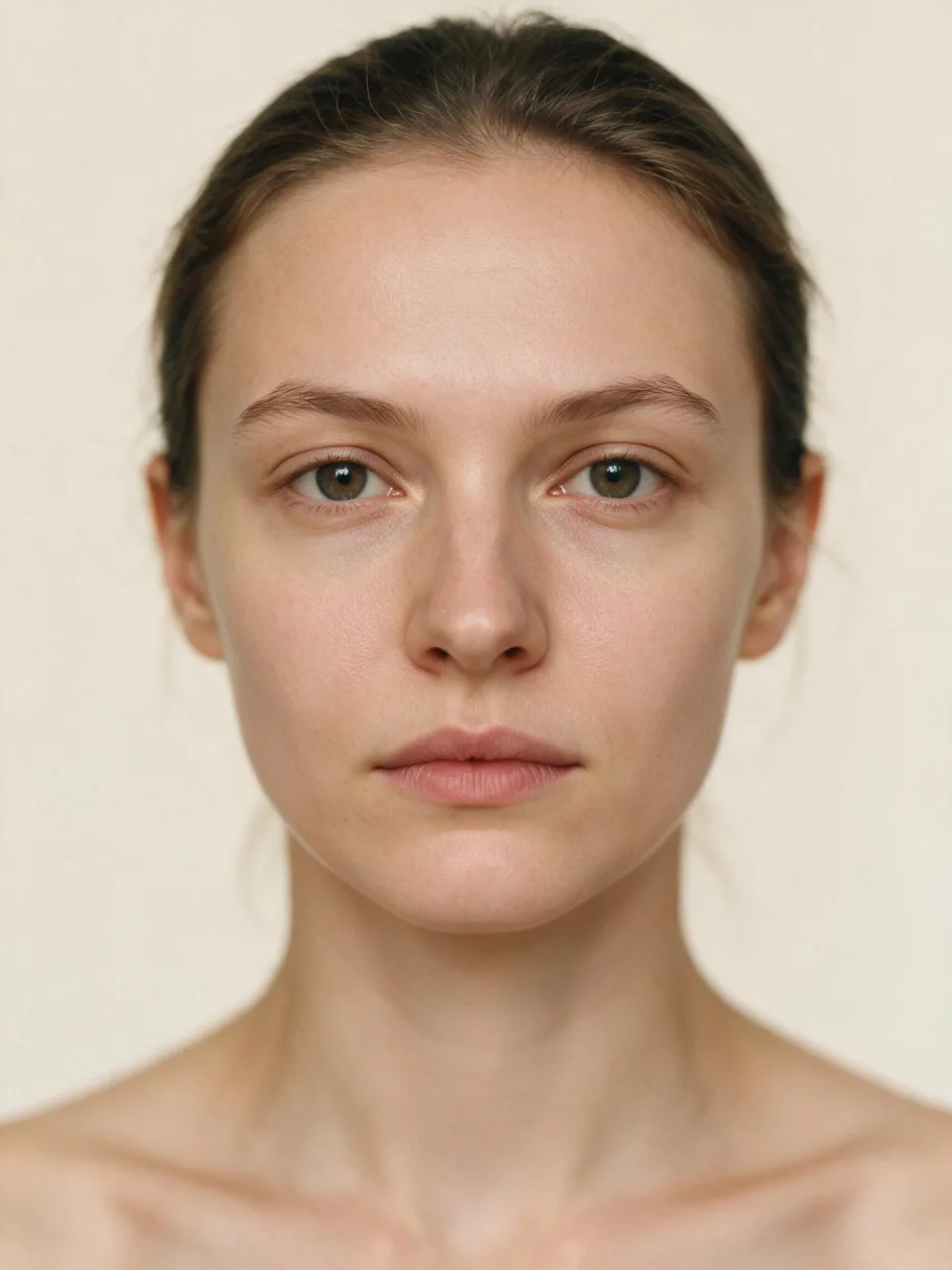
EXAMPLE ANALYSIS: 478 LANDMARKS MAPPED ON A SAMPLE PHOTO, NOT YOURS.
What a reading looks like
Real components · sample dataA starting line, not a verdict.
What we won't show you: a confidence band (not until our test-retest study ships) · a percentile (not until a reference population is published) · a skin score from one photo (lighting lies). Every "not scored" comes with its reason.
Face shape is decided by four measurements, forehead width, cheekbone width, jaw width and face length, and the ratios between them, not by eyeballing an outline.
This AI facial analysis measures forehead, cheekbone and jaw width against face length, analyzed on your device, and returns your class, plus the margin to the next class. A class describes the outline in one photograph. It does not rank you.
The Short Version
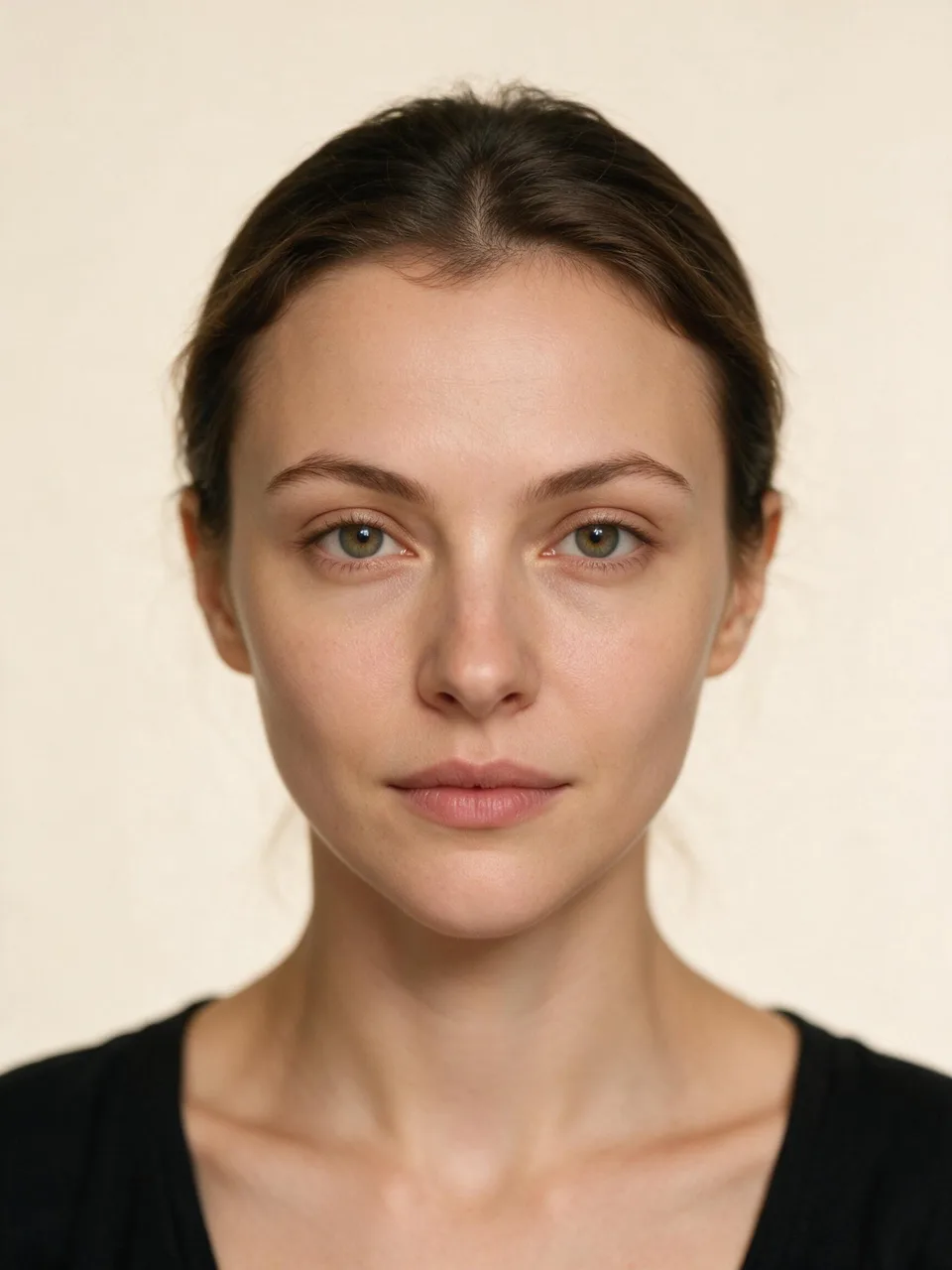
Each of the seven shapes is a different relationship between four measurements: face length, forehead width, cheekbone width and jaw width. The detector reads those from the landmark mesh and reports which pattern your numbers sit closest to, along with how close the call was.
How Can I Identify My Face Shape?
You can identify your face shape from one straight-on photo by comparing four measurements, forehead width, cheekbone width, jaw width and hairline-to-chin length, against each other.
This detector runs the same comparison on a live photo. A browser-based landmark mesh finds the four points, measures each span, and applies the classification rules published below. You can run the identical comparison yourself, with a tape measure and five steps.
- Pull your hair back off your forehead and both temples.
- Measure straight across the widest part of your forehead.
- Measure across your cheekbones, just below the outer corners of your eyes.
- Measure jaw angle to jaw angle, at the widest point below your ears.
- Measure from your hairline to the point of your chin.
A phone, a tape measure and the classification rules below return the same class this detector does.
How This Detector Measures Your Face, and What It Does About the Hairline
This detector runs a 478-point MediaPipe landmark mesh in your browser, fits a horizontal eye line to correct for head tilt, and reads four spans from the corrected mesh. Forehead width runs across the widest visible span of your forehead. Cheekbone width, the bizygomatic width, runs across the widest point of your face, just below your outer eye corners. Jaw width runs gonion to gonion, the two points where your jaw turns up toward your ears. Face length runs from your visible hairline to menton, the lowest point of your chin. Each measurement is reported with both endpoints named, so you can check it against your own photo.
The classical face length starts at the trichion, your natural hairline, and no landmark model can see a hairline through hair. Every detector on this search result either guesses that point or quietly substitutes a forehead landmark instead. This one publishes the substitute it uses, a fixed visible-window convention, and lets you place a marker on your own hairline to see how the class changes.
The three ratios that decide your class
Three comparisons decide every class: face length against cheekbone width, jaw width against cheekbone width, and forehead width against cheekbone width.
Cheekbone width is the reference each ratio uses, because it is the most visible span on a straight-on photo. A high length-to-cheekbone ratio pushes the class toward the longer shapes. Whichever of jaw and forehead measures wider than the other decides which of those longer or shorter shapes it becomes.
The Seven Face Shapes, and the Rule That Decides Each One
Seven classes cover this taxonomy: oval, round, square, heart, diamond, oblong and triangle, ordered here by search volume rather than by preference. Each one is defined by which of the three measurements is widest and by how long the face reads against that width. No class in this order ranks above another.
| Shape | Length to cheekbone width | Widest measurement | Jaw outline | The rule that decides it | Read the guide |
|---|---|---|---|---|---|
| Oval | Longer than wide | Cheekbones | Rounded, narrower than the cheekbones | Cheekbones widest, jaw narrower, length moderately greater than width | oval face shape |
| Round | Close to equal | Cheekbones | Soft and curved, no sharp angle | Cheekbones widest, length and width close to equal | is my face round or oval |
| Square | Close to equal | Forehead, cheekbones and jaw near equal | Strong, angular jaw | Forehead, cheekbones and jaw close in width, jaw angle reads sharp | square face shape |
| Heart | Longer than wide | Forehead | Narrow, tapering to a point | Forehead widest, jaw narrowest, chin tapers | heart face shape |
| Diamond | Longer than wide | Cheekbones | Narrow forehead and jaw, pointed chin | Cheekbones widest, forehead and jaw both narrower | diamond face shape |
| Oblong | Notably longer than wide | Forehead, cheekbones and jaw near equal | Straight sides, minimal taper | Forehead, cheekbones and jaw run near equal width, length clearly greater | oblong face shape |
| Triangle | Close to equal | Jaw | Widest at the jaw, narrow forehead | Jaw widest, forehead narrowest | triangle face shape |
None of these seven rules stands alone. A face longer than it is wide still reads as round when the width difference between forehead, cheekbones and jaw stays small, because the length ratio and the width order are checked together, not one after the other. That is also why two people with the same length-to-width ratio land in different classes: the second test, which measurement is widest, is doing real work.
Rectangle, long, and pear: the names that mean the same shapes
Rectangle and long are other names for oblong, and pear is another name for triangle. The alias changes the label, not the measurement.
The Rules This Detector Classifies By
This detector assigns a class with two published tests run together: a ratio test comparing face length to cheekbone width, and a width order test ranking forehead, cheekbone and jaw width against each other. A jaw angle test separates the angular classes, square and triangle, from the curved ones. Every threshold behind those tests is fixed under one version, Shape v1.0, and published in full on the measurement points, the thresholds and the version.
| Class | Ratio test | Width order test | Jaw angle test |
|---|---|---|---|
| Oval | Length moderately greater than width | Cheekbones widest | Curved, not angular |
| Round | Length close to width | Cheekbones widest | Curved, not angular |
| Square | Length close to width | Forehead, cheekbones and jaw close | Sharp and angular |
| Heart | Length greater than width | Forehead widest | Curved to angular, tapering |
| Diamond | Length greater than width | Cheekbones widest, forehead and jaw both narrower | Curved, pointed chin |
| Oblong | Length notably greater than width | Forehead, cheekbones and jaw close | Straight sides |
| Triangle | Length close to width | Jaw widest | Sharp at the jaw |
A result counts as a genuine tie when the winning class's rule score sits within a published margin of the runner-up's. That margin is fixed on the same methodology page and printed again on every result card, so the number a visitor sees in the result region matches the number printed there. The thresholds are chosen first and published before this page goes live, and a later change carries a dated changelog entry, because a class that flips six months later deserves a reason.
What If You're Between Two Face Shapes?
Many faces sit between two classes, and this detector prints the margin so you can see when yours does.
A margin is the distance between your winning class and the runner-up, and it is what a class name alone can never show. When that distance falls under the published tie threshold, the result is a genuine two-class tie, not a misclassification. Both guides apply, and the styling advice from two neighboring classes mostly agrees anyway, because the underlying measurements are close. This is the section every boundary question on this topic is really asking about: oblong against oval, round against oval, heart against diamond. None of those visitors were misclassified. Their face sits near a line, and the margin says exactly how near.
What Anthropometry Calls Face Shape, and What It Publishes
Anthropometry does not use these seven names. It uses the morphological facial index, face height divided by cheekbone width, sorted into five phenotype bands.
These are anthropometric studies of specific national samples. They measured an index rather than our seven classes, and they report distributions, not verdicts about any one face. Two studies below name their population and sample size for exactly that reason.
| Study | Population and n | Mean facial index, M / F | Most common phenotype | Least common phenotype |
|---|---|---|---|---|
| Choudhary et al. 2026 [2] | 200 Indian medical students | Reported by sex, index-based | Mesoprosopic, 34.5% | Hypereuryprosopic and hyperleptoprosopic, 11.0% each |
| Zhong and Tong 2024 [3] | 476 Tibetan youth | 80.86 male, 83.91 female | Hypereuryprosopic, 45.6% (male) | Hyperleptoprosopic, 1.2% (male) |
The styling taxonomy this page uses has no published population distribution of its own. And the one time a face shape typology was tested against an independent measurement, Williams' claim that face shape predicts tooth form, the association was not significant, tested biometrically in 1987 [4] and again with digital tracings on 200 subjects in 2019 [5].
Face Shape for Men and Women
The same seven classes and the same thresholds apply to every face. This detector takes no sex or gender input.
Measured facial dimensions do differ by sex. In a 200-subject index study, men's facial height, bizygomatic breadth and facial index were all significantly greater than women's [2]. But the distribution of the five anthropometric phenotypes across that same sample did not differ significantly by sex, chi-square 6.07, 4 degrees of freedom, p equal to 0.194 [2], measured by the same dimorphism approach used across this literature [12].
What Is the Most Attractive Face Shape?
No face shape class ranks above another in the research, which measures other things entirely.
Here is what the evidence says. Shape symmetry, averageness and sexual dimorphism, measured from images and tested together, found that averageness predicted attractiveness ratings in both male and female faces, and femininity predicted them in female faces, while masculinity and symmetry did not [6]. That is the strongest single result in this literature, and it does not mention outline categories at all.
Morphometric masculinity told the same story a second way. A discriminant function that classified over 96% of faces correctly by sex showed no relationship with rated attractiveness, while skin colour did [7]. A measurement built specifically to separate male and female face shape still failed to predict how attractive either group was rated.
The review position agrees: averageness, symmetry and sexual dimorphism are the studied dimensions of facial attractiveness [8][9], and none of them is which of six or seven outline categories a face falls into. Your class does not set how attractive you are. It tells you which proportions a style choice is working with.
Can AI Detect Face Shape? And What Makes One Detector Better Than Another?
Yes, a landmark model measures the four spans and applies a rule, which is reproducible in a way human judgement is not.
People classifying face shape by eye show very low agreement, between different viewers, within the same viewer, and even across repeated presentations of the same photograph to the same person, and training in the method did not improve face-matching accuracy [1]. A model that measures the same four points every time and compares them against a fixed rule does not have that problem.
That also answers what makes one face shape detector better than another: the one that names which points it measured, which rule it applied, and how close the call was, not the one with the most confident font. This detector publishes no accuracy percentage, because no validation study exists yet to justify one. See how we measure, and where the measurement fails.
What This Score Cannot Tell You
You now have a class and the four measurements behind it. What is left is what that class is worth, how to check it, and what would change it.
You Have a Shape Now, What Does It Actually Mean?
Your class is a summary of four measurements, forehead width, cheekbone width, jaw width and face length, sorted through published rules. Three questions matter now: what the label is actually worth, how to confirm it before you act on it, and what could change it. The three sections below take them in order.
What a shape label is actually worth
A class is a bucket, and the margin is how confidently your measurements landed in it. Neither one is a score. A wide margin means your face sat clearly inside one class; a narrow one means it sat close to a line between two. This page has no score to interpret, so the module that usually explains what your score means points instead to where the site's actual score vocabulary lives: what a 1-10 attractiveness score really means. A descriptive class and a 1-10 attractiveness score answer two different questions.
How to confirm your shape before you act on it
- Retake the photo with your hair fully back off your forehead and both temples.
- Use your rear camera at arm's length or further, with the lens level at eye height.
- Keep your chin level and your expression neutral, with your mouth closed.
- Compare the four measurements themselves, not just the class name, between the two photos.
A gap smaller than your printed margin is noise from the photo, not a new face. A gap that flips your class is the system telling you your face sits close to a boundary, which is a correct result, not an error.
What changes your face shape, and what only changes the photo
The photograph moves your result fastest and most. Hair over your temples, a tilted chin, camera distance and a smile all shift the measured outline immediately, and none of them touch your face [13]. Soft tissue moves it slowly: facial width correlates with body weight, at r equal to 0.378 in men and 0.291 in women in one 476-subject index study [3], and facial adiposity is readable from a photograph on its own [11]. Your skeleton moved it once, a long time ago. The growth trajectory that set your facial proportions runs through adolescence and is largely complete by your early twenties [10], and no routine reaches it now.
What Your Shape Changes: Hairstyles, Glasses, and Beards
Once you know your class, three styling routes use it as an input, each running on its own balance rule rather than a style list.
- Hair: balances the length of your face against its width.
- Frames: contrast your face's dominant line instead of repeating it.
- Beard shape: changes the jaw outline this detector just measured.
Face shape is one input among several. Hair texture, density, lifestyle and your own preference matter just as much, and this page does not pretend a class is a prescription. Glasses, beard styling and colour analysis all use the same class as an input; hairstyles chosen by face shape gets its own guide once it publishes, and until then the seven class guides above carry the route.
What Else the Same Scan Measures
The same landmark mesh that found your face shape runs the composite that scores every metric at once. Analyse your whole face reports each measurement with its own unit and its own tolerance, rather than folding face shape into a single number.
The namesake instrument on this site is the attractiveness test, which turns those measurements into the 1-10 score this page deliberately does not produce. This page does not re-explain face shape there, and it does not re-explain that score here.
You have a class and the citations behind it. The report ranks your own measurements in the order worth working on and re-scores them on day 30.
Not medical advice. This is a measurement of a photo, not a diagnosis, a clinical assessment, or a verdict on you.
It measures geometry, not worth. The number tells you where you start. It never tells you what you are.
on every page
of this site
Your report, in full.
- Side profile
- Skin, measured properly
- Averageness
- Dimorphism
- Ranked plan
Paid photo deleted within 24 hours · never used for training
- 40+ measurements, 7 regionsPP. 2-9
- Side profile, from a second photoPP. 10-13
- What moved your score, rankedPP. 14-16
- Four week plan and day 30 re-scanPP. 17-20
Frequently Asked Questions
Is there an app to find my face shape?
No app is required. This detector runs free in any mobile or desktop browser, with no account, and most face-shape apps on the market send your photo to a server instead. You can confirm that by opening your browser's network tab while it runs.
Do face shape filters actually measure anything?
No. A filter draws a moving overlay on your face without comparing any two points, so it returns an effect rather than a measurement. The one question worth asking any filter is which two points it measured between, and most cannot answer it.
Is a face type detector the same as a face shape detector?
Yes. Face type and face shape name the same job, sorting a face into a class by comparing its widths against its length. The word a given tool uses for its output carries no extra meaning beyond that.
What is the difference between an oblong and an oval face?
Both are longer than they are wide, and the difference is the width pattern: an oval tapers gently from the cheekbones to the jaw, while an oblong runs at close to equal width from forehead to jaw with straighter sides. That single measurement test separates the two shapes, not any softer impression.
Is a triangle face the same as a pear or a heart face?
Pear is another name for triangle, jaw widest, while heart is its inverse with the forehead widest. Inverted triangle is usually being used for what this page calls a heart face shape.
Can my face shape change over time?
The measured outline changes with weight, age, hairstyle and facial hair, while the growth that set your underlying proportions runs through adolescence and is largely complete by your early twenties [10]. This page covers what the outline does, not how to change it.
Do glasses frames really depend on face shape?
Frames work on contrast: a shape that cuts against your face's dominant line reads as balancing it. Face shape is one input among several, ahead of size and fit but behind neither.
What is the difference between a face shape analyzer, detector, finder, and calculator?
All four name the same job; analyzer, detector and finder usually work from a photo, while calculator usually means typing in your own tape measurements. This page supports both routes, because its classification rules are published rather than hidden.
Why did two face shape detectors give me different answers?
Three reasons explain most disagreements: a different class count, six versus seven, a different hairline convention, and unpublished thresholds that cannot be compared. A tool that prints neither its rule nor a margin cannot be checked against another one.
Is my photo uploaded when the detector runs?
No. The landmark mesh, the four measurements, your class and the annotated overlay are all produced inside your browser, and nothing is transmitted while you measure. Sharing your result is a separate, two-step choice, covered on the privacy page.
Should I choose a hairstyle by face shape at all?
It is one useful input and not the deciding one; hair texture, density, growth pattern, lifestyle and what you actually like all matter just as much. Treat a face shape as a starting point for a haircut conversation, not a rule for one.
References
Every claim above, traceable
- Towler A, White D, Kemp RI, Perception 2014 - face-shape classification by eye showed very low agreement between viewers, within viewers and across repeated presentations of the same image, and training did not improve face-matching accuracy.
- Choudhary U, Akhtar MJ, Gupta M, More RS, Mishra A, Cureus 2026 - facial index study of 200 medical students: mesoprosopic 34.5%, euryprosopic 28.5%, leptoprosopic 15.0%, hypereuryprosopic and hyperleptoprosopic 11.0% each; men measured significantly greater facial height, bizygomatic breadth and facial index (p < 0.001, p = 0.006); phenotype distribution not significantly associated with sex (chi-square 6.07, df 4, p = 0.194).
- Zhong H, Tong Q, Journal of Craniofacial Surgery 2024 - morphologic facial index of 476 Tibetan youth: male facial index 80.86 +/- 5.82, female 83.91 +/- 11.90; facial width correlated with BMI (r = 0.378 in males, r = 0.291 in females).
- Seluk LW, Brodbelt RH, Walker GF, Journal of Oral Rehabilitation 1987 - the first biometric test of the face-shape-to-tooth-form typology, finding significant differences between facial form and denture teeth (p < 0.001).
- Mehndiratta A, Bembalagi M, Patil R, Journal of Prosthodontics 2019 - digital tracings of 200 subjects found the association between face shape and tooth form was not statistically significant.
- Lee P, Li J, Rafiee Y, Jones BC, Shiramizu VKM, Scientific Reports 2025 - averageness predicted facial attractiveness judgments in male and female faces, and femininity predicted them in female faces, while masculinity and symmetry did not.
- Scott IM, Pound N, Stephen ID, Clark AP, Penton-Voak IS, PLoS One 2010 - a discriminant function classifying over 96% of faces correctly by sex found masculine face shape showed no relationship with rated attractiveness, while skin colour did.
- Rhodes G, Annual Review of Psychology 2006 - review of the evolutionary psychology of facial beauty, naming averageness, symmetry and sexual dimorphism as the studied dimensions of facial attractiveness.
- Perrett DI, Lee KJ, Penton-Voak I, et al., Nature 1998 - the founding experiment on sexual dimorphism and facial attractiveness.
- Knigge RP, McNulty KP, Oh H, et al., American Journal of Orthodontics and Dentofacial Orthopedics 2021 - longitudinal cephalograms of 371 participants show facial proportion follows a growth trajectory established through adolescence.
- Coetzee V, Perrett DI, Stephen ID, Perception 2009 - facial adiposity is readable from a photograph as a cue to health.
- Da Silva C, Hoskens H, Aponte JD, et al., Journal of Anatomy 2026 - methods for measuring sexual dimorphism in human faces.
- Ward B, Ward M, Fried O, Paskhover B, JAMA Facial Plastic Surgery 2018 - short-distance photographs distort facial proportions, the mechanism behind the selfie effect.
- Lugaresi C, et al., MediaPipe: A Framework for Building Perception Pipelines, Google Research, 2019 - the landmark model this widget runs on, an engineering source rather than a research finding about faces.