AI Golden Ratio Face Calculator: Thirds, Fifths, and fWHR
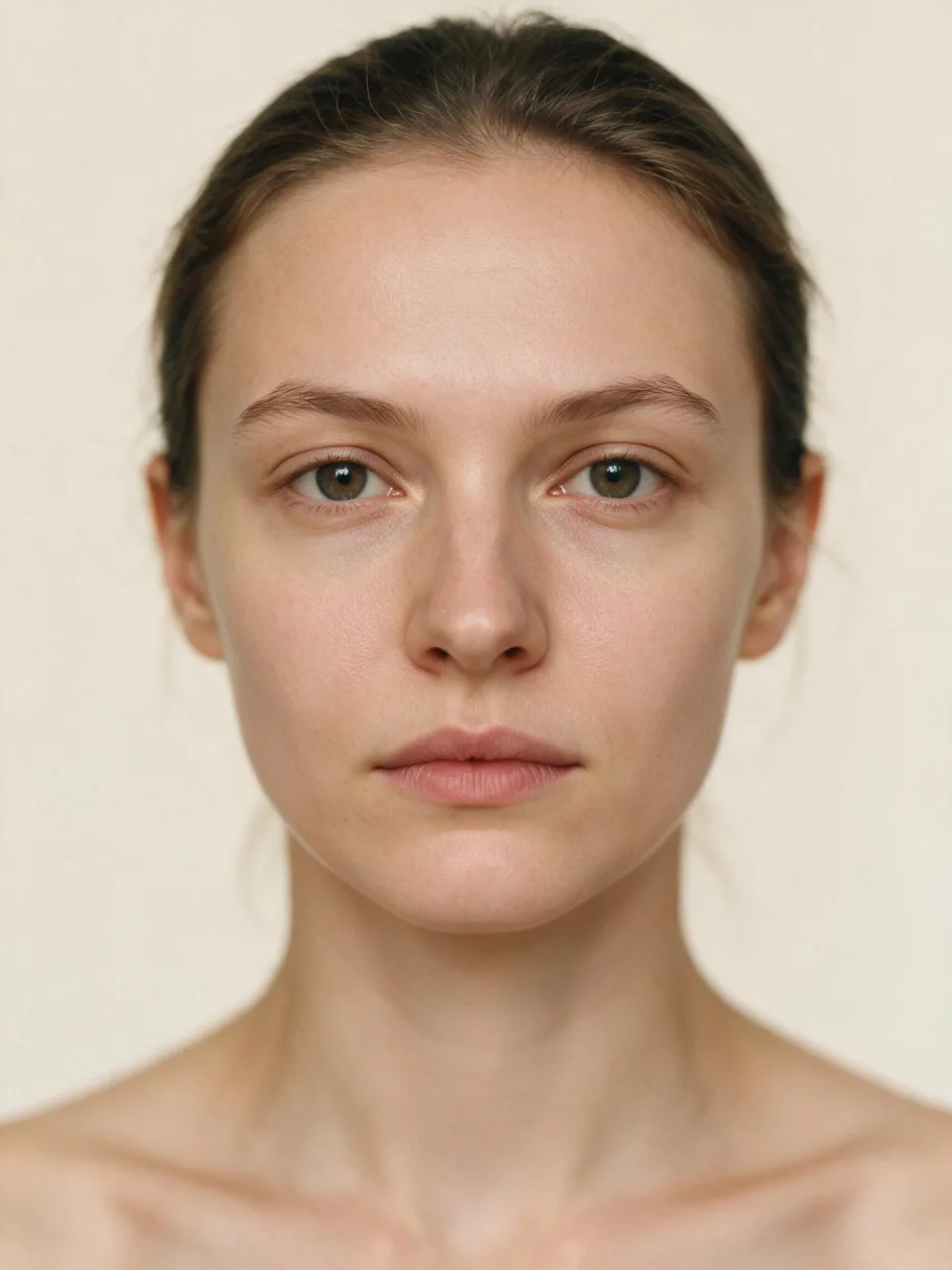
EXAMPLE ANALYSIS: 478 LANDMARKS MAPPED ON A SAMPLE PHOTO, NOT YOURS.
What a reading looks like
Real components · sample dataA starting line, not a verdict.
What we won't show you: a confidence band (not until our test-retest study ships) · a percentile (not until a reference population is published) · a skin score from one photo (lighting lies). Every "not scored" comes with its reason.
No study shows faces at phi = 1.618 are reliably rated more attractive; the golden ratio is a descriptive convention, not a measured driver. It measures your length-to-width ratio against 1.618, plus thirds, fifths, fWHR and midface, on your device.
The Short Version
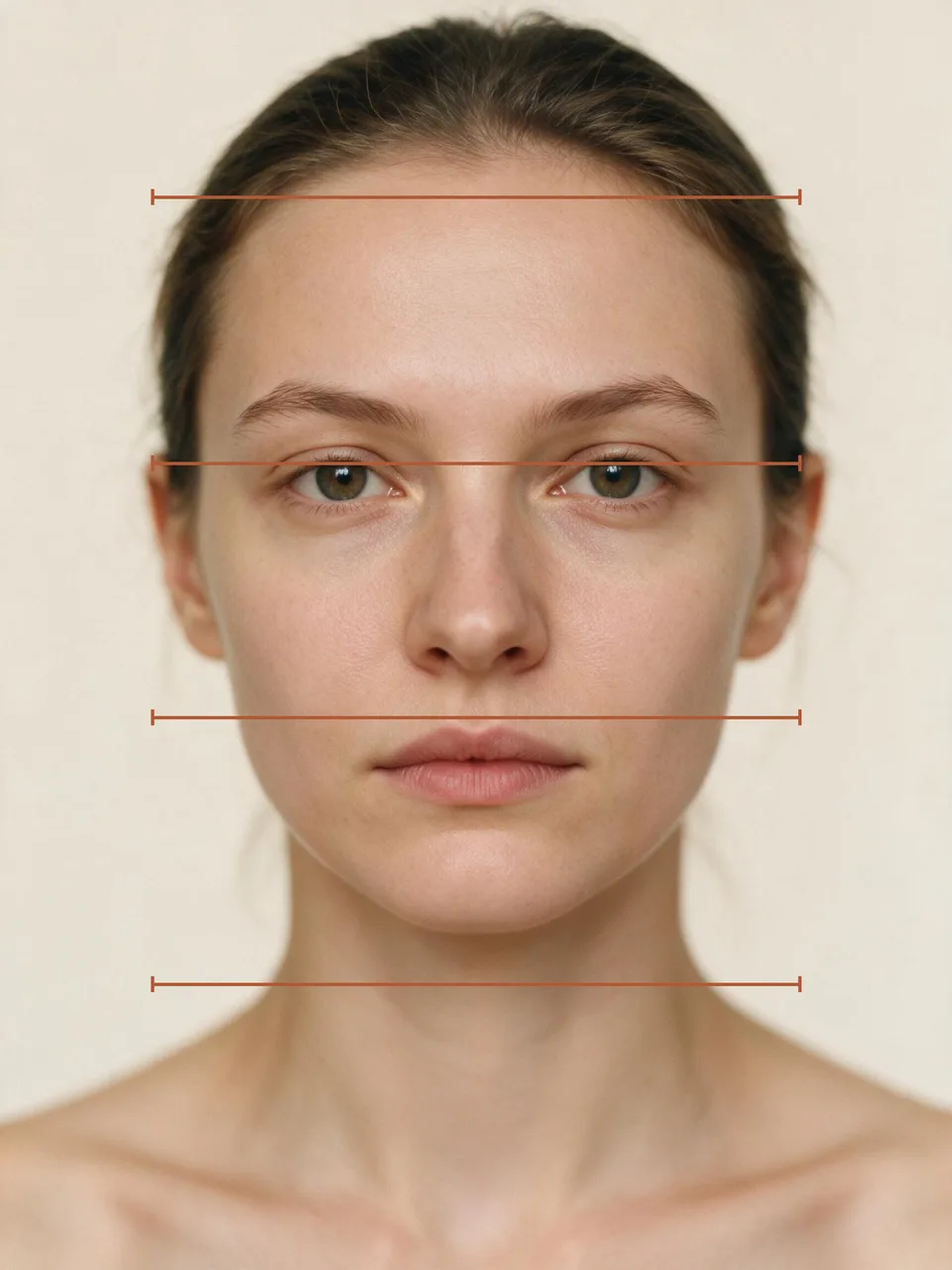
The lines are the measurement. Face length against cheekbone width gives the headline ratio, and the horizontal bands show how the thirds compare. Every line here is computable from the landmark mesh, which is why the page can show its work instead of asking you to trust a number.
How Do I Find My Golden Ratio for My Face?
You find your golden ratio for your face by dividing your face height by your face width from one straight-on photo, then comparing that number with 1.618.
This calculator performs the same division after mapping 478 points across your face. It measures the distance from your forehead top, or your hairline if you place it, down to your chin, divides that by the width across your cheekbones, and returns the ratio in under two seconds.
- Take a straight-on photo at eye level with your phone's rear camera.
- Mark your hairline and the bottom point of your chin.
- Mark the widest point across your cheekbones.
- Divide the hairline-to-chin height by the cheekbone width.
- Compare the result with 1.618, the reference value most calculators use.
A phone, a straight edge and a calculator return the same number this tool does, measured on your device, without uploading the photo you used to take it.
What Is a Golden Ratio Face? Phi, 1.618, and the Divine Proportion
A golden ratio face is a face whose measured proportions, most often face height divided by face width, are compared against phi, 1.618. The comparison is a convention, not a property a face has.
Phi, written φ, is the number produced when a line is divided so the whole line relates to its longer part the same way the longer part relates to its shorter part. That ratio, roughly 1.618, is also called the golden proportion, the divine proportion, the phi ratio and, in some corners of the industry, the beauty ratio. On a face, the comparison usually runs from the forehead top, or the hairline, down to the chin, divided by the width across the cheekbones.
Where the phi mask came from
The phi-based facial canon is a twentieth-century construction. Stephen Marquardt built his widely used mask in 2002 from a small sample of faces already judged attractive. He fit a decagon of golden-ratio proportions to that sample rather than predicting the proportions from phi and then confirming them by measuring faces. Nearly every calculator on this topic, including this one, measures against that same convention rather than a proportion recovered from classical art or anatomy [5][10].
How This Calculator Measures Your Ratios, and What It Does About the Hairline
This calculator, checker and analyzer fits a 478-point mesh to your photo, finds your eye line, and corrects for head roll before measuring anything. Your length-to-width ratio runs from your forehead top, or your hairline if you place it, to the bottom of your chin (the menton), divided by the width between your cheekbones (your bizygomatic width). Thirds run hairline to brow line to nose base to chin; fifths run across five columns from ear to ear; fWHR divides bizygomatic width by upper-face height. Every ratio prints with the two points it used, so you can verify it against the same photo.
The classical 1.618 target is defined from the trichion, where your hairline meets your forehead, and no landmark model can see a trichion under hair, a hat or a hood. Every other calculator on this results page either guesses that point or silently swaps in a visible forehead landmark without saying so. This tool discloses that limit instead. It publishes a visible-window target derived from its own stated landmark, and lets you place your own hairline marker so the classical figure comes from your actual hairline, not a guess.
Your Length-to-Width Ratio: The Number People Mean by "Golden Ratio Face"
There is no golden ratio face score that counts as good. This tool reports a proximity percentage: how close your length-to-width ratio sits to the 1.618 convention, using this tool's own endpoints.
Your result shows two numbers: your length-to-width ratio, for example 1.42, and a proximity percentage stating how close that ratio sits to 1.618, using this tool's own endpoints and hairline convention. Another calculator's 87% is not this calculator's 87%, because the endpoints and the hairline assumption behind each score usually differ. A high proximity percentage means your measurements sit near a widely used convention, nothing more: a description, not a verdict, a starting line for comparison rather than a rating.
People searching for a "perfect face ratio," a "golden ratio percentage," or "ideal facial ratios" are usually hoping a pass-or-fail number exists; this tool reports distance from a convention instead, not a grade. A high proximity score also places you inside a labeled band for context on the site's Attractiveness Score scale. It is not a percentile and not a clinical category, and what that convention has actually been measured to predict is covered next.
Facial Thirds and Fifths: The Canon That Divides Your Face
Facial thirds and facial fifths are not the golden ratio at all. They come from a different, older tradition, the neoclassical facial canons, an equal-division system that later got folded into golden-ratio pages, including much of this search results page. Both canons divide the same face this calculator already measured.
The facial thirds test: upper, middle, and lower
The facial thirds test divides your face into three bands: hairline to brow line, or glabella (upper); brow line to the nose base, or subnasale (middle); and nose base to the bottom of your chin, or menton (lower).
Each band is measured as a percentage of your total face height, with 33.3% as the equal-thirds reference for all three. A longer lower third usually means more distance between your nose and chin. A shorter middle third usually means a shorter nose-to-lip span. Neither direction is a defect: it is a measurement of where your proportions sit relative to an equal-division reference, published for the populations named below [6][7].
Facial fifths: the five-eye-width rule
The facial fifths canon holds that a face divides into five vertical columns, each about one eye-width wide, so the gap between your inner eye corners (your interocular distance) equals the width of one eye.
This canon carries no recorded search volume of its own, but it is half of the horizontal neoclassical canon and it is named in this tool's own title. It also quietly corrects a claim in Google's AI Overview for this topic, which states the eye-spacing rule as settled fact without measuring a single face.
fWHR and Midface Ratio: Two Ratios That Are Not the Golden Ratio
Facial width-to-height ratio (fWHR) divides your bizygomatic width, the width across your cheekbones, by your upper-face height, measured from your brow line to the top of your upper lip [11]. Midface ratio divides your midface length, from the middle of your eyes to the corner of your mouth, by the width across your midface. Both are printed with the vertical anchor this tool used, because published fWHR values are only comparable to each other when the vertical anchor matches. A value measured brow-to-lip is not the same number as one measured hairline-to-lip, even on the same face.
| Ratio | What it measures | Research status |
|---|---|---|
| Golden ratio (1.618) | Face height compared with face width, from forehead top or hairline to chin, over cheekbone width | An aesthetic convention with no measured attractiveness advantage in direct tests [1][2] |
| fWHR | Bizygomatic width divided by upper-face height | A research construct linked in one meta-analysis to perceived dominance and aggression, with a small but significant association [12] |
| Midface ratio | Midface length divided by midface width | A descriptive proportion with no validated aesthetic target |
A 2015 meta-analysis found a small but significant association between men's fWHR and aggressive behavior [12]. A 2016 study found fWHR was not associated with adolescent testosterone during the years facial growth is set [13]. Read together, the two studies bound the same claim: fWHR correlates weakly with some measured behavior, and its hormonal cause is not established.
How Often Real Faces Actually Match These Canons
Most measured faces do not match the neoclassical canons, and match rates have been published by population: two horizontal canons held in 40% and 37% of one Caucasian sample, and equal facial thirds held in neither Caucasian nor Asian samples.
The studies below are anthropometric measurements of healthy faces. Each one measured how often a published neoclassical canon held on real faces, by named population, not how attractive anyone in the sample was. None of them measured this tool's score, and none of them license a group-specific target.
| Canon | Population | Match rate | Source |
|---|---|---|---|
| Horizontal facial-width canons (two of the set) | Young adult North American Caucasians | Held in 40% and 37% of faces measured | [6] |
| Vertical profile canons | Young adult North American Caucasians | Held far less often than the horizontal canons in the same sample | [6] |
| Equal facial thirds | Asian and Caucasian adults | Held in neither ethnic group measured | [7] |
| Other five neoclassical canons | Caucasian vs. Asian adults | 16.7% to 36.7% of Caucasian faces versus 1.7% to 26.7% of Asian faces | [7] |
| Full neoclassical canon set | International sample across multiple ethnic groups (n = 1,470) | Values differ by ethnic group; no single canon held universally | [9] |
| Neoclassical canon revisions | Afro-American adults | Documented separately revised proportion values for this population | [8] |
The pattern across four studies is consistent: neoclassical canons hold for a minority of measured faces, at rates that shift meaningfully between populations. A horizontal canon that holds in 40% of one Caucasian sample [6] can hold in under 2% of an Asian sample measuring the same proportion [7]. That range is the reason this tool reports your raw ratios and their measurement points, tied to a named reference population, rather than converting any of them into a pass-or-fail grade.
What the Evidence Says About Phi and Facial Beauty
The most direct test of golden proportions on real faces found only a weak link to rated beauty. Kiekens and colleagues scored 19 putative golden proportions against laypeople's ratings of 64 adolescents. Four of the 19 correlated significantly with rated attractiveness, together explaining 16% of the variance, a share the study's own authors judged too small to be of clinical importance [2]. That finding does not mean phi has zero relationship to rated beauty; it means the relationship, where it exists, is too small to anchor a scoring system on.
A separate experiment measured the ideal arrangement directly instead of assuming it was phi. Pallett, Link and Lee ran four experiments and found rated attractiveness peaked when eye-mouth distance measured about 36% of face length, and interocular distance measured about 46% of face width [1]. Those optima matched averageness, the resemblance of a face to the mathematical average of many faces, not phi. This tool prints both of your matching ratios beside those measured targets, which no other calculator on this topic's results page does.
The review literature reaches a cautious conclusion. A 2024 review by Naini describes the golden ratio's link to facial esthetics as unsupported by the weight of the evidence [3]. A second 2024 review found no significant association between the golden ratio and facial evaluation scores across the ethnic groups it studied [4]. Neither claims phi is disproven; both state it has not been demonstrated as a driver of rated beauty.
The mask's own provenance is worth stating on its own. A Procrustes analysis by Holland found Marquardt's phi mask most closely describes the facial proportions of masculinized white fashion models, and fits non-European faces poorly [5]. A separate clinical paper by Kim still uses the mask as a diagnostic aid for facial harmony [10]. Together, the two papers describe a mask built from a narrow sample: clinically useful to some, poorly generalized to most.
The Golden Ratio Face for Men and Women
Published canon studies find only small differences between men's and women's facial proportions, not large enough to justify separate targets for each sex [6][9]. The clearer finding is about the mask itself, not about faces. Holland's analysis of Marquardt's phi mask found that its proportions most closely matched masculinized white fashion models [5], the opposite of how a golden ratio face for women is usually marketed. This tool applies the same measurement points and the same convention to every face it measures, regardless of sex, and reports the same limits either way.
Which Celebrities Have a Golden Ratio Face?
Celebrity golden-ratio rankings come from phi-mask overlays applied to press photographs, not from measurement studies, so no verified celebrity ranking exists to report.
Most "golden ratio face" celebrity lists trace back to a phi-mask overlay laid over a red-carpet photograph, published as promotional material, then recycled by listicle sites that rarely check the math. That's a media format, not a measurement study, and it's the kind of finding a press release will not put in its own headline. This tool does not measure, estimate or publish the facial geometry of any named person, living or dead, because a red-carpet photo was never taken under this tool's pose, distance or lighting conditions.
What This Score Cannot Tell You
Read the complete list of endpoints, conventions and limits in how we measure, and where the measurement fails.
The measurement account above is complete. What follows is about the number you just got: the convention it was measured against, whether it is stable, and what a different measurement says about the same photograph.
Where Does the Number Come From in the First Place?
Your ratio did not come from your face alone. It came from your face, measured, and then compared against a convention that a person chose, in this case a twentieth-century mask fitted to a small sample of faces. That raises three questions in order: can you confirm the number, what actually moves it, and what a different convention says about the same photograph.
How to confirm your ratio before you believe it
- Retake the photo at arm's length or further, with the camera at eye height.
- Hold your chin level and keep your expression neutral, with your mouth closed.
- Pull your hair back off your forehead so the measurement can see it.
- Compare the raw ratios between the two photos, not the proximity percentages.
If your two ratios differ by more than a rounding error, that difference is almost always the photo, not your face. The fix is to retake it under the conditions above rather than trust either number alone. See what a 1-10 attractiveness score really means for how a component measurement like this one fits the site's wider score vocabulary.
What actually changes your ratios, and what only changes the photo
Three things move these numbers, in order of how much control you have. The photograph moves them most: camera distance, lens choice, chin angle, expression and hair covering the forehead change your ratios immediately, and close-range photos distort central features relative to the outline [14]. Soft tissue moves them gradually: weight and age change face width and lower-third fullness over months and years, shifting fWHR and your thirds more than your headline ratio. The skeleton barely moves: face length, cheekbone width and jaw width are set by your early twenties and aren't moved by routines, supplements or exercises.
What a different standard says about the same face
The same photograph, scored for symmetry instead of proportion, returns a different number about a different property, and the two disagree constantly. A face can sit close to the 1.618 convention and still be measurably asymmetric, or the reverse can be true. Symmetry has the stronger research support of the two, with a documented, if modest, correlation to rated attractiveness, while golden-ratio proximity explains a smaller share by comparison [2]. Find out how symmetrical your face actually is on the same photograph, measured the same way.
Is the Golden Ratio Face Calculator Accurate?
This calculator is accurate in the sense that matters most: it reproduces the same measurements from the same photograph and the same software version every time.
Reproducibility is the accuracy claim this tool makes, and it is narrower than being right about your face. It refuses side and three-quarter photos rather than return a ratio describing head rotation instead of proportion, which is part of that claim, not an apology for it. It publishes no accuracy percentage, because an honest answer needs a validated reference standard for facial proportion that doesn't exist yet. Two calculators can measure the identical photo and disagree, almost always because their endpoints and hairline conventions differ, not a software bug. See the measurement points, the version and the test-retest data for the full account.
What Else Is Worth Measuring on a Face
Proportion is one of several measurements this site runs on the same landmark mesh. The full AI face analysis scores every component at once, including proportion, and shows how each contributes to your overall result.
The full attractiveness test is this site's namesake instrument: the same 478-point mesh, reported as a single 1 to 10 score.
All fourteen numbered sources below are peer-reviewed and indexed in PubMed. One additional source, Marquardt's original 2002 account of the phi mask, is not indexed in PubMed and is described on this page only through Holland's peer-reviewed analysis [5].
Not medical advice. This is a measurement of a photo, not a diagnosis, a clinical assessment, or a verdict on you.
It measures geometry, not worth. The number tells you where you start. It never tells you what you are.
on every page
of this site
Your report, in full.
- Side profile
- Skin, measured properly
- Averageness
- Dimorphism
- Ranked plan
Paid photo deleted within 24 hours · never used for training
- 40+ measurements, 7 regionsPP. 2-9
- Side profile, from a second photoPP. 10-13
- What moved your score, rankedPP. 14-16
- Four week plan and day 30 re-scanPP. 17-20
Frequently Asked Questions
Is this the same as a golden ratio calculator for design or mathematics?
No. Phi, 1.618, is the same number used in design and math, but this tool applies it only to facial measurements, not shapes, layouts or spirals.
Why is the golden ratio called the beauty ratio?
The name comes from twentieth-century aesthetic writing, not from a measured link between phi and rated beauty. Direct tests of the connection have found it small at best.
Which facial third is usually the longest?
Published measurements most often find the lower third the longest of the three in young adult faces. An unequal third is a normal, measured pattern, not a defect.
Do golden ratio face apps, filters and overlay templates measure the same thing?
No. Most apps, filters and overlay templates draw a mask over your photo without measuring anything. Before trusting one, ask between which two points its number was measured.
Can you measure the golden ratio on a side profile?
No. Classical facial ratios are defined on a front-facing view, and a side profile measures different things entirely, such as convexity and projection angles. This tool refuses a profile photo rather than return a ratio that means something else.
Is a high fWHR a sign of aggression or dominance?
A small but significant association exists between men's fWHR and aggressive behavior, though a later study found no link between fWHR and adolescent testosterone. Neither finding licenses reading a person's character from a single ratio.
Why does my ratio change between two photos?
Chin angle, camera distance and expression each move your measured ratios, and close-range photos distort them the most. Compare your raw ratios, not your proximity percentages, between the two photos.
Does a low golden ratio score mean my face is unattractive?
No. The proximity score measures distance from a convention the strongest direct test found explains about a sixth of rated-beauty variance, and most measured faces sit away from it. A low score is a measurement fact, not a verdict.
Can surgery or fillers move my face closer to the golden ratio?
Surgical procedures can change measured facial proportions, but a photograph and a ratio cannot tell you whether to have one. That decision belongs with a qualified clinician who has examined you in person.
Where does my photo go when I use this calculator?
Your photo, the mesh, every ratio and the overlay are produced in your browser, and nothing is transmitted unless you choose to share your result. Read the full explanation in how your photo is processed.
Did Leonardo da Vinci use the golden ratio for facial proportions?
No verified evidence supports that claim. The classical proportion system linked to Renaissance art, including Vitruvian Man, uses simple whole-number ratios, and the phi-based facial canon used today is a twentieth-century construction.
References
Every claim above, traceable
- Pallett P.M., Link S. and Lee K., Vision Research 2010 - four experiments found rated attractiveness peaked when eye-mouth distance measured about 36% of face length and interocular distance measured about 46% of face width, matching the average face rather than phi.
- Kiekens R.M. et al., American Journal of Orthodontics and Dentofacial Orthopedics 2008 - 4 of 19 putative golden proportions correlated significantly with rated facial esthetics in 64 adolescents, together explaining 16% of the variance.
- Naini F.B., Maxillofacial Plastic and Reconstructive Surgery 2024 - review describing the golden ratio's claimed link to facial esthetics as unsupported by the weight of the evidence.
- Londono J. et al., Journal of Prosthetic Dentistry 2024 - systematic review found no significant association between the golden ratio and facial evaluation scores across the ethnic groups studied.
- Holland E., Aesthetic Plastic Surgery 2008 - a Procrustes analysis found Marquardt's phi mask most closely matches masculinized white fashion models and fits non-European faces poorly.
- Farkas L.G. et al., Plastic and Reconstructive Surgery 1985 - measured neoclassical facial canon match rates in young adult North American Caucasians, including 40% and 37% for two horizontal canons.
- Le T.T. et al., Aesthetic Plastic Surgery 2002 - equal facial thirds held in neither Asian nor Caucasian samples; the other five neoclassical canons held in 16.7% to 36.7% of Caucasians versus 1.7% to 26.7% of Asians.
- Farkas L.G., Forrest C.R. and Litsas L., Aesthetic Plastic Surgery 2000 - revised neoclassical facial canon values for young adult Afro-American faces.
- Farkas L.G. et al., Journal of Craniofacial Surgery 2005 - international anthropometric study of facial morphology across multiple ethnic groups, 1,470 subjects.
- Kim Y.H., Journal of Craniofacial Surgery 2007 - describes clinical use of the facial golden mask as a diagnostic aid for facial harmony.
- Carre J.M. and McCormick C.M., Proceedings of the Royal Society B 2008 - introduced facial width-to-height ratio (fWHR) and linked it to aggressive behavior in laboratory and hockey-player samples.
- Haselhuhn M.P., Ormiston M.E. and Wong E.M., PLOS ONE 2015 - meta-analysis found a small but significant association between men's fWHR and aggression.
- Hodges-Simeon C.R. et al., PLOS ONE 2016 - found fWHR was not associated with adolescent testosterone levels.
- Ward B. et al., JAMA Facial Plastic Surgery 2018 - short-distance photographs distort facial proportions, the selfie effect.