You have an oval face shape when your face length runs about 1.5 times your width, your cheekbones sit as the widest point, and your jaw and forehead taper into a softly rounded chin with no sharp angle anywhere.
This guide gives you the checklist, the measurements behind it, six real examples and the styling logic that keeps an already balanced oval face from being over-corrected. Face shape here is a styling heuristic sourced from geometry, never a beauty ranking.
The Short Version
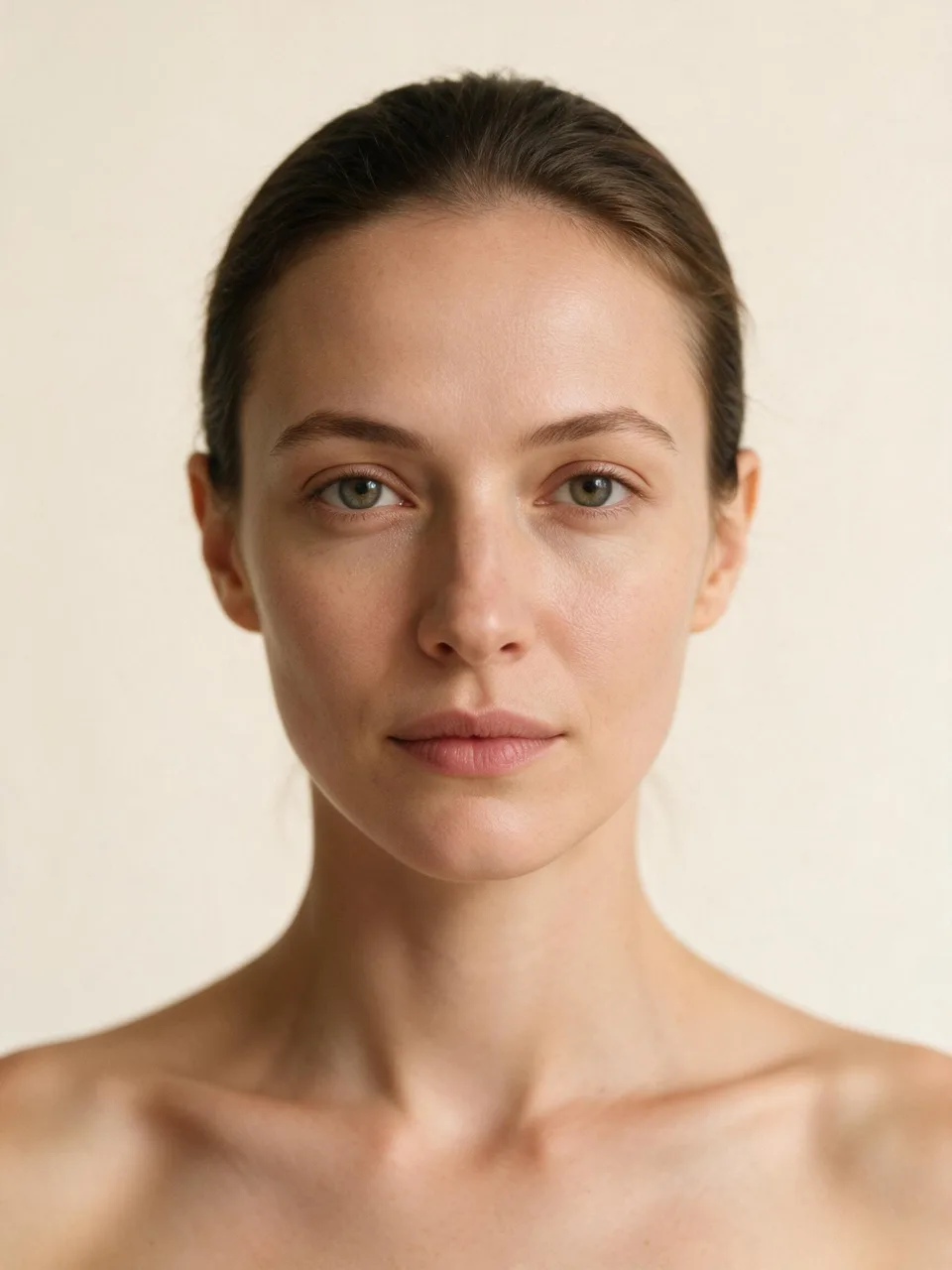
This is the geometry the detector reads, not a style or a look. On a front photo the classifier compares face length against width and the three widths against each other, and the oval pattern is the combination described here. Hair, expression and camera angle change how a face reads to people; they also change the landmarks, which is why the scan asks for a level, front-facing photo.
How to Tell: The Oval Face Checklist
An oval face shape is defined by four measurements, forehead width, cheekbone width, jaw width and face length, and by the ratios between them, not by tracing an outline in a mirror. Cheekbone width sets the reference point, because it is the widest, most visible span on a straight-on photo. On an oval face, that width narrows gently toward both the forehead and the jaw, rather than repeating itself at any other measurement. The length test does the rest of the work: an oval face reads noticeably longer than it is wide, without running as long as an oblong face does. Each criterion below checks one part of that pattern, and a face that satisfies most of them belongs in this class even when one measurement sits close to a boundary.
- Face length runs about 1.5 times face width, noticeably longer than it is wide.
- Cheekbone width is the widest measurement on the face, wider than both the forehead and the jaw.
- Forehead width sits slightly wider than jaw width, not equal to it.
- Jaw width narrows into a softly rounded chin, with no sharp corner anywhere along the jawline.
- No single measurement dominates the face: forehead, cheekbones and jaw taper into each other evenly.
How Oval Is Different From Round and Oblong
Oval is most often confused with round and oblong, because all three keep the cheekbones at or near the widest point. Round is the closer mix-up: a round face keeps its length close to its width, near a 1:1 ratio, while an oval face runs about 1.5 times longer than it is wide. Oblong sits on the other side of oval: an oblong face runs notably longer again, and its forehead, cheekbones and jaw stay close to the same width instead of narrowing toward the jaw, so its sides read straight rather than tapered. The fastest check between the three compares length against width first, then checks whether the sides taper, which reads oval, or run straight, which reads oblong.
The AI Face Shape Detector runs this same comparison automatically. Its browser-based landmark mesh measures forehead, cheekbone and jaw width against face length, corrects for head tilt on its own, and applies the same width-order and length-ratio rules to sort a longer-than-wide face with the cheekbones widest and no jaw angle into the oval class. It also prints the margin to the next-closest class, a number a mirror check cannot give you.
The Measurements Behind It
Face shape classification rests on four measurements, forehead width, cheekbone width, jaw width and face length, each taken as a straight span rather than an estimate. Forehead width runs across the widest visible point of the forehead. Cheekbone width, the bizygomatic width, runs across the face just below the outer corners of the eyes. Jaw width runs from one gonial angle to the other, the points where the jawline turns up toward the ears; on an oval face, that angle reads soft and rounded rather than sharp, so the width comparison matters more than the angle itself. Face length runs from the hairline to the chin. An oval face carries a length near 1.5 times its width, cheekbones as the single widest span, and a forehead measuring only slightly wider than the jaw. The most common self-measurement error tilts the chin up or down while measuring cheekbone width, which shortens or lengthens the reading by several millimeters. This AI facial analysis corrects that automatically: a horizontal eye line straightens the photo before any span is measured, on-device, before a single number is recorded.
Oval Faces at a Glance
Six public figures are widely described in mainstream style coverage as having an oval face shape, spanning both long and short hairstyles.
- Bella Hadid, styled with both center parts and sleek low buns.
- Jennifer Lawrence, styled with soft waves and shoulder-length cuts alike.
- Gal Gadot, styled with a deep side part and long layers.
- Cameron Diaz, styled with long layers framing the jaw.
- Ryan Gosling, styled with a classic side part and a short crop.
- Idris Elba, styled with a close, tapered cut.
For Men and For Women
The four-measurement definition of an oval face shape is sex-neutral: the same ratios, cheekbones widest, forehead slightly wider than jaw, length near 1.5 times width, sort a face into the oval class regardless of gender. Two presentation differences show up in practice without changing the underlying class. A hairline pattern differs by sex on average, and a receding or widow's-peak hairline can visually shorten or lengthen the forehead span a scan reads, without moving the jaw or cheekbone measurements at all. Jaw muscle mass also runs higher on average in men, which can make an oval jaw read slightly more defined at the same width measurement. Neither difference changes which class a face belongs to; both change how obvious the class looks at a glance.
What Flatters an Oval Face
An oval face starts from an already balanced set of ratios, so the styling job here is smaller than it is for any other shape: confirm the balance, then avoid undoing it. Because forehead, cheekbone and jaw width already sit close together with no dominant angle, almost any hairstyle, part or frame shape reads as proportionate on an oval face, the opposite problem from a shape that needs active correction. The one caution worth stating plainly: a full, blunt fringe cut straight across the brow shortens the face length that makes the ratio balanced in the first place, pulling a 1.5-to-1 face toward the rounder end of the scale. A side-swept or textured fringe avoids that effect, because it does not run the full width of the forehead. A dedicated hairstyle guide for oval faces and a matching glasses guide are both coming; until they publish, the rule above carries the same logic either way, styling that respects an existing balance rather than a shape that needs solving.
The seven-shape system used across this site is a styling convention rather than a clinical classification, and no published study validates the oval class specifically. Its core comparison, face length measured against the widest facial width, is the same logic behind the morphological facial index anthropometry already uses. Here is what the evidence says about that method: a 2024 study measured the facial index of 476 Tibetan youth by comparing face height to cheekbone width directly, the same relationship this page's length-to-width ratio checks.
Not medical advice. This page describes a styling classification from a photo, not a diagnosis, a clinical assessment or a verdict on you.