You have a round face shape when your face length and width sit close to equal, your cheekbones are the widest point, and your jaw and forehead curve with no angle anywhere, stated as a one-sentence test.
This guide covers the checklist that confirms a round face shape, the faces that share it, and the styling logic that balances it. Face shape is a styling heuristic sourced from geometry here, not a beauty judgment: no shape on this site outranks another.
How to Tell: The Round Face Checklist
A round face shape shows up in four measurements: forehead width, cheekbone width, jaw width and face length. The test that separates round from every other class is how close face length sits to face width, and which of the three widths, forehead, cheekbone or jaw, measures widest. A round face keeps length and width close to a 1 to 1 ratio, closer than an oval's longer proportions, and puts the cheekbones out ahead of both the forehead and the jaw. Face length itself runs from the visible hairline to the point of the chin, the same endpoint every shape on this site uses. A length read for a round face therefore compares directly against a length read for any other class. The checklist below states each relationship in the same four terms used across every shape guide on this site, so a face shape read here matches a face shape read anywhere else on it.
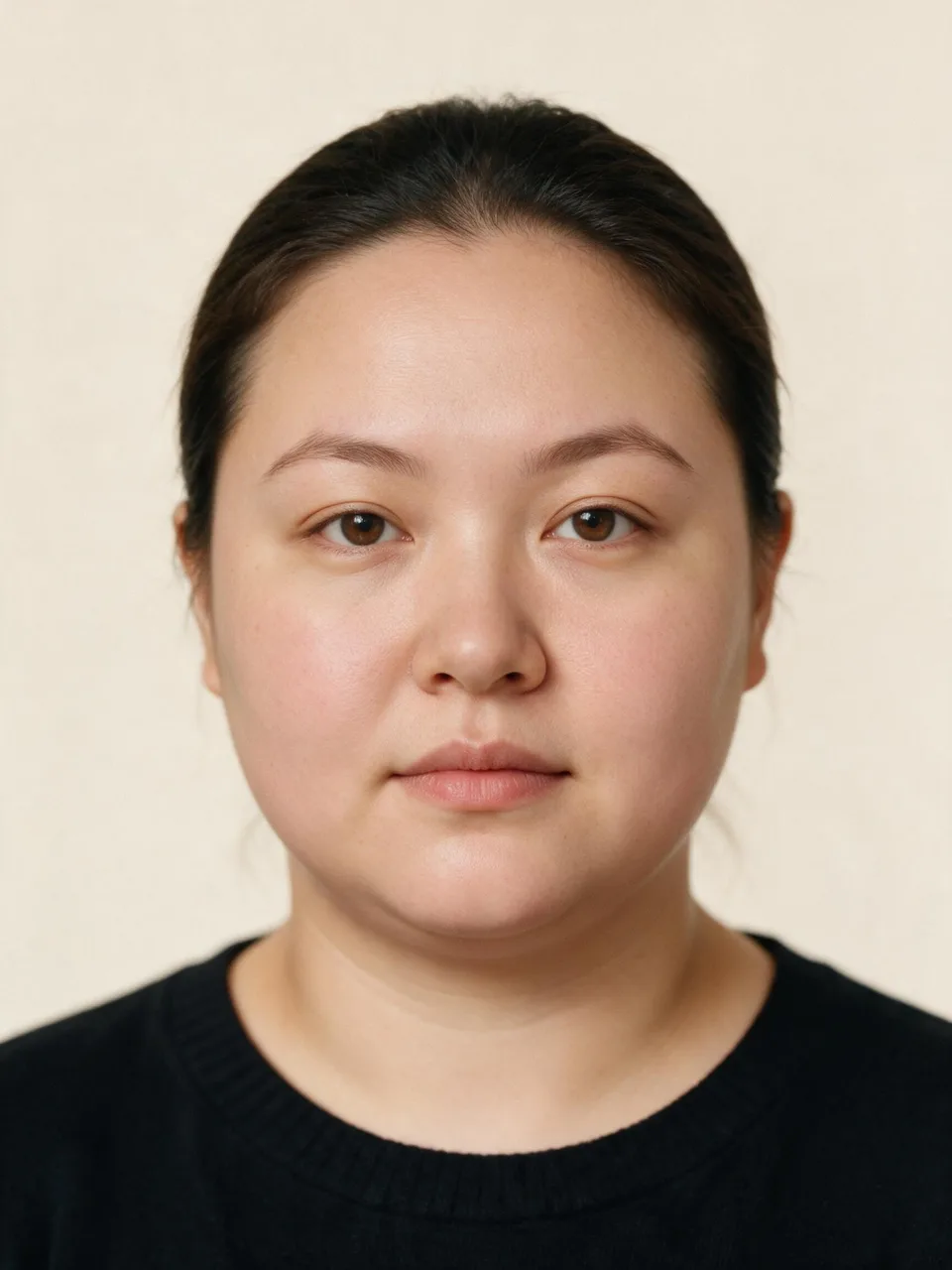
This is the geometry the detector reads, not a style or a look. On a front photo the classifier compares face length against width and the three widths against each other, and the round pattern is the combination described here. Hair, expression and camera angle change how a face reads to people; they also change the landmarks, which is why the scan asks for a level, front-facing photo.
- Face length close to face width, near a 1 to 1 ratio
- Cheekbones sitting as the widest measurement on the face
- Forehead width and jaw width close to each other, both narrower than the cheekbones
- A jawline that curves into the cheek with no angled corner
- A softly rounded chin, the detail that separates round from square
A mirror test can misjudge these widths by an inch or more, depending on angle and lighting. Instead, measure your face shape automatically: the same four spans are read from a photo in your browser, on-device, with no upload.
The Measurements Behind It
Four measurements decide every face shape class: forehead width, cheekbone width, jaw width and face length. For a round face, cheekbone width is the widest of the three spans. Forehead and jaw width sit close to each other and narrower than the cheekbones, and face length runs close to face width rather than clearly longer. Cheekbone width, the bizygomatic span just below the outer corner of each eye, works as the reference point for every ratio in this system. It is the widest and most visible span on a straight-on photo. That near equal length to width ratio is also what a round face shares with a square face. The jaw test decides that pair instead: a square jaw turns at a near right angle you can feel with two fingers at the corner, while a round jaw curves without a distinct corner at all. Against an oval face, the length test does the separating instead, since an oval runs noticeably longer than it is wide while a round face does not. The measurement most people get wrong by hand is jaw width. A tape held at the wrong angle under the ear reads several centimeters short, and a mirror adds its own distortion on top of that. This AI facial analysis corrects for both errors by finding the actual jaw corner, gonion to gonion, on a face held level to the camera. That is the same correction a mirror and a bent tape cannot make.
Round Faces at a Glance
The round class includes faces widely and consistently described that way across published style coverage, not one reference face. Each name below matches at least two lines of the checklist above, not just a general impression of roundness.
- Mila Kunis, whose cheekbones read as the clear widest point
- Kirsten Dunst, with jaw width and forehead width close together
- Chrissy Teigen, whose face length sits close to face width
- Ed Sheeran, with a curved jawline and no angled corner
- Leonardo DiCaprio, with a rounded jaw and a softly curved chin
Every face above still varies in expression, hairstyle and camera angle, which is exactly why the four measurements, not a single reference photo, are what decide the class.
For Men and For Women
The same four measurements define a round face shape for every face, regardless of sex: forehead width, cheekbone width, jaw width and face length read the same way and cross the same thresholds. Anthropometric studies that track those four spans by sex find real differences in the raw numbers. One 200-person facial index study measured men's facial height, cheekbone width and overall facial index as significantly greater than women's [1]. The same study found the spread of shape classes across that sample was not significantly tied to sex [1]. Two presentation differences are worth naming on top of that. A receding or M-shaped hairline in men shortens the visible forehead, which can pull a naturally round face toward reading more oval in a photo taken before the jaw is measured. A more developed jaw muscle, from clenching or diet, can add a faint edge to a jaw the four-measurement test still scores as curved rather than angular. Neither difference moves the face into a different class on its own.
What Flatters a Round Face
A round face already has width working for it at the cheekbones, so the styling logic runs the other way: add vertical height and add angles, rather than adding more width or more curve. Height at the crown, through a cut, a part, or a lift, stretches the face longer on the vertical axis and works against the near 1 to 1 ratio a round face measures. An angled or textured layer, especially one ending at or below the jaw, breaks up the jawline's own curve and introduces the corner a round face doesn't have on its own. The same principle carries over to a beard: added density along the jawline reads as the same corner effect, without lifting anything at the crown at all. The changes to avoid run the opposite way. A blunt, chin length cut sitting right at the widest point of the cheekbones repeats the curve instead of countering it, and heavy volume held at cheek level does the same. This is a balance heuristic, sourced from geometry rather than ranked by style, and it holds whether the choice is a haircut, a beard shape, or a frame. The specific haircuts that apply this logic get their own guide once that page publishes, and the glasses frames that apply the same contrast rule to a round face will get one too. Until then, this page's checklist and the four measurements above are what to check a stylist's suggestion against.
The four measurement, ratio based method this page uses traces to anthropometric facial index research [1]. That research divides face height by cheekbone width and sorts a sample into phenotype bands, rather than the seven styling classes named here. That is what the evidence says about the classification's own grounding: a measurement method drawn from a research tradition, applied here as a styling heuristic rather than a clinical one. The same source and the same four-measurement grounding apply across every face shape guide on this site, cited once here rather than repeated on each one.
Not medical advice. This page describes a styling classification, not a diagnosis, a clinical measurement, or a ranking of how attractive a face is.