The eyebrow shape that balances your face does the opposite of your face's dominant line: angled arches lengthen a round face, softer curves ease an angular one, and flat brows visually shorten a long one.
This guide compresses the brow-studio consensus into one page: the arch, length and thickness that balance each of the seven face shapes, and the reasoning behind every call. Brows sit on the one horizontal line the eye reads first, so a small change in arch height shifts how long or wide the whole face appears. Face shape is a styling heuristic read from geometry, never a beauty ranking: no shape on this page outranks another.
The Short Version
Why the Arch Does the Opposite Work
An arch balances a face by pulling the eye against the face's strongest line. A high, angled arch adds vertical lift, which is why it lengthens a face that measures nearly as wide as it is long. A flat brow adds horizontal width, which is why it shortens a face that runs long. The seven-shape system reads four measurements (forehead width, cheekbone width, jaw width and face length), and the brow is the styling tool closest to three of them.
One measurement settles the starting point. The AI face shape detector reads all four spans from one photo and names your shape, with the margin to the next closest class. It runs as on-device AI facial analysis: the photo never leaves your browser.
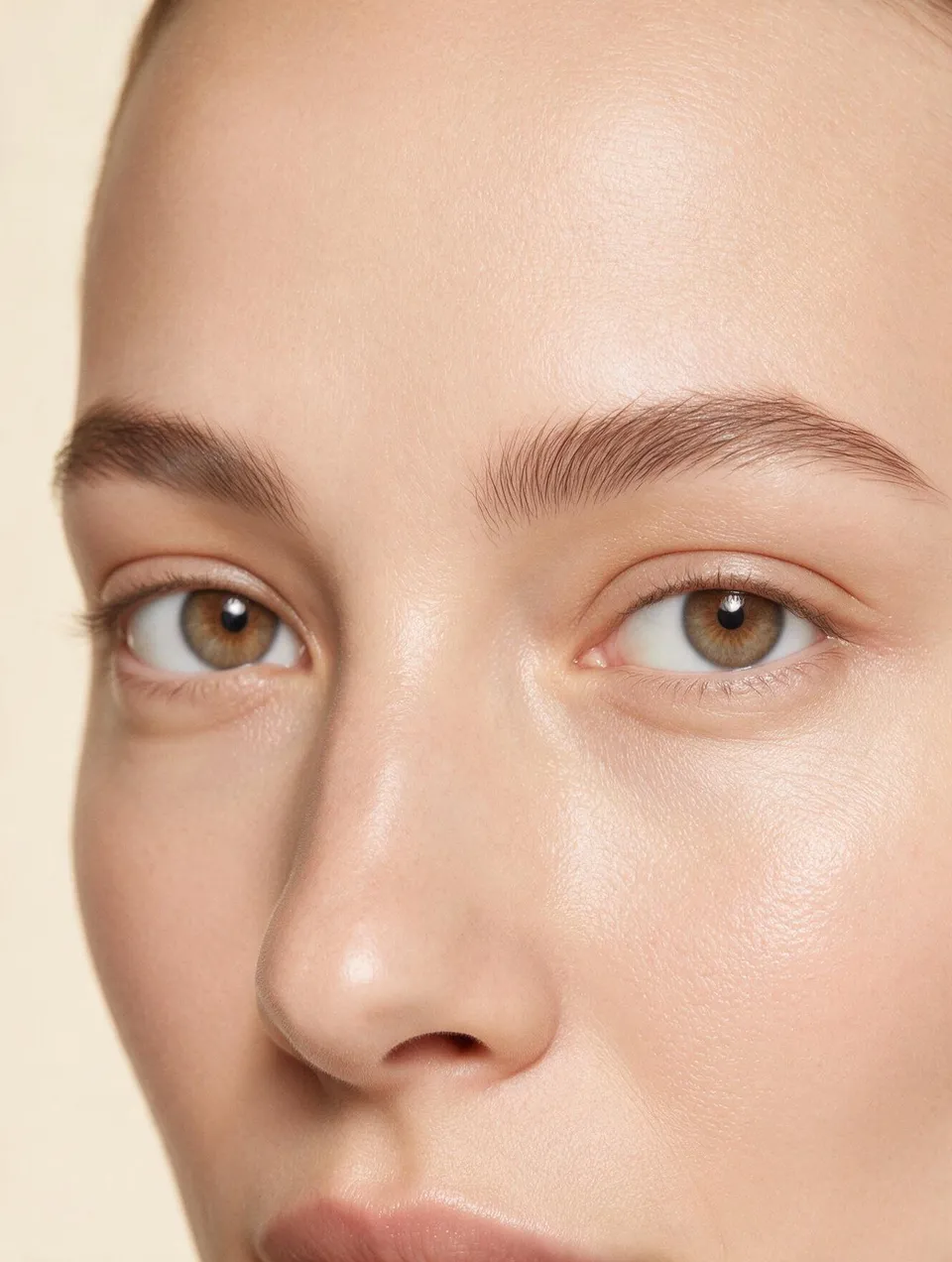
This is the raw material every recommendation below starts from: a natural brow at full thickness, arch left alone. The brow line sits closer to three of the four measurements than any other feature you can style, which is why the same untouched brow gets an opposite instruction on a round face and a long one. Confirm the shape first; the shaping call follows from the measurements, not from the brow itself.
All Seven Shapes at a Glance
The table gives one row per face shape, and the sections below add the reasoning plus where the published charts disagree. They do disagree in one place, and this page says so rather than papering over it.
| Face shape | Arch | Length and thickness | Why it balances |
|---|---|---|---|
| Oval | Soft, shallow arch | Natural thickness, standard tail | The ratios are already even; the brow's job is not disturbing them |
| Round | Lifted, angled arch | Defined body, tail kept crisp | Vertical lift lengthens a face that is nearly as wide as it is long |
| Square | Soft curve or gently defined arch | Full but not blocky | Curve eases an angular jaw and forehead; hard lines repeat them |
| Heart | Low to medium, softly rounded | Moderate thickness, no drama | A modest arch avoids adding height to the widest span, the forehead |
| Diamond | Rounded, curved arch | Balanced, slightly fuller body | Curve softens the cheekbone point and widens the narrow forehead |
| Oblong | Flat, straight brow | Extended tail for width | Horizontal lines add width and visually shorten a long face |
| Triangle | Soft arch with an extended tail | Fuller, longer brow | Width added up top narrows the gap to a jaw that measures widest |
Oval: A Soft Arch, Left Alone
An oval face takes most brow shapes, and the studio consensus lands on soft angles with a shallow arch as the default. The face already runs balanced, with cheekbones as the widest point, so the brow has nothing to correct. The risk is over-styling: a dramatic high arch or a hard flat line adds a correction the geometry never asked for. The oval face shape guide has the checklist to confirm you are starting from balance.
- Shape: a soft, shallow arch at natural thickness.
- Avoid: dramatic arches or hard flat lines that over-correct a balanced face.
- The balance reason: even ratios need preserving, not fixing.
Round: Lift the Arch, Add the Angle
A round face takes a lifted, angled arch, the most agreed-on call in the whole brow chart. Every fetched source lands on the same logic: vertical lift lengthens a face that measures nearly as wide as it is long, and the angle adds a line the soft curves lack. The same sources agree on the miss: rounded brows mirror the face's curve and make it read wider, and flat brows do the same. The round face shape guide covers the near 1 to 1 ratio behind the rule.
- Shape: a high, angled arch with a crisp tail.
- Avoid: rounded brows and flat brows, which repeat the curve or add width.
- The balance reason: lift adds the vertical line a wide, soft face is missing.
Square: Soften the Corners
A square face softens its brow, though this is one row where the charts split on how far. One studio guide recommends a soft, curved brow to ease the angular jaw and forehead; another backs a stronger brow with a defined arch for balance. Both agree on the direction: nothing blocky, nothing that repeats the right angles the face already has. A gentle curve or a softly defined arch reads as the safe consensus. The square face shape guide covers the matching widths that set this rule.
- Shape: a soft curve, or a gently defined arch if you want more structure.
- Avoid: hard, straight lines and boxy shaping that echo the jaw's corner.
- The balance reason: curve is the one line an all-angles face does not already have.
Heart: Keep the Arch Modest
A heart face keeps its arch low to medium and softly rounded, because the forehead is already the widest span and a tall arch adds height exactly there. This is the one shape where the published charts genuinely disagree: one source recommends high arches for heart faces, while two others advise a low or low to medium arch and warn against anything that accentuates the forehead. This page sides with the majority and the geometry. The heart face shape guide maps the taper that decides it.
- Shape: a softly rounded brow with a low to medium arch.
- Avoid: tall, angular arches that add drama to the widest part of the face.
- The balance reason: quiet brows keep attention moving down toward the narrow chin, not up.
Diamond: Curve Against the Point
A diamond face takes a rounded, curved brow, because the cheekbones are the widest, sharpest span and curve softens the point. The studio consensus adds a second job: a slightly fuller brow widens the appearance of a narrow forehead, which closes the gap to the cheekbones from above. The diamond face shape guide has the measurements behind both moves.
- Shape: a rounded arch with a slightly fuller body.
- Avoid: sharp, angular peaks that repeat the cheekbone point.
- The balance reason: curve softens the widest span while fullness widens the narrowest one.
Oblong: Go Flat, Go Wide
An oblong face flattens the brow, the strictest single rule in the chart. A straight, flat brow with a longer tail adds horizontal width, which visually shortens a face that already runs long. High arches get an explicit warning in the sources: they add vertical lift to the one measurement that dominates. The oblong face shape guide explains why every styling call on this shape pushes sideways.
- Shape: a straight, flat brow, soft at the edges, with an extended tail.
- Avoid: high arches, which lengthen a long face further.
- The balance reason: horizontal lines are width, and width is what a long face lacks.
Triangle: Extend the Tail, Build the Top
A triangle face wears its brows fuller and longer, because the jaw is the widest span and the forehead the narrowest, so visual weight belongs up top. Most brow charts skip this shape entirely; the one fetched source that covers it (under the name pear) recommends an extended tail past the outer eye corner, because the added line widens the upper face. On this site, triangle means the jaw outmeasures both the cheekbones and the forehead; half the charts online use the label for the opposite taper, so match the measurements, not the name. The triangle face shape guide sorts out the naming confusion.
- Shape: a soft arch with a fuller body and a tail extended past the outer eye corner.
- Avoid: thin, short brows that leave the narrow forehead bare against a wide jaw.
- The balance reason: length and fullness up top narrow the measured gap to the jaw.
Brows Are the Upper Third's Styling Tool
Brows balance the upper third of the face the way a haircut balances the outline and a beard redraws the jaw. The moves stack: a round face pairs its angled arch with height at the crown, and an oblong face pairs its flat brow with side volume. The best hairstyle for your face shape and glasses by face shape run the same seven-shape logic. On method: tweezing, waxing and threading all get you to any shape on this page; semi-permanent routes like microblading exist and belong with a licensed professional. The honest boundary holds here too: face shape is geometry, not a score, and no brow change moves a measurement.
The recommendations on this page are studio consensus drawn from published brow and grooming guides, fetched and compared for this page, not peer-reviewed evidence. No study ranks brow shapes by face shape, and where the guides disagreed (the heart face arch), the disagreement is printed above rather than hidden. The balance logic itself is the same four-measurement geometry the face shape system runs on.
Not medical advice. This page describes a styling heuristic read from geometry, not a diagnosis, a clinical assessment, or a verdict on you.