The best hairstyle for your face shape follows one rule: add visual length to a wide face, add width to a long face, and soften whichever angle reads strongest. Only an oval face needs nothing added, just preserving.

Every face shape haircut rule on this page reduces to that one principle. A haircut cannot move bone, but it can add height, width, weight or curve exactly where the underlying geometry lacks it, and that is all any of the seven shape rules do. This guide states the rule for each of the seven shapes in one short section, then hands you to a dedicated haircut guide per shape with named cuts for men and for women. Face shape here is a styling heuristic sourced from geometry, never a beauty ranking.
The Short Version
The One Rule: Balance Length Against Width
The rule behind every face shape haircut is proportional: a cut adds volume or line where the face measures least, and takes emphasis away from where it measures most. Four measurements decide the starting point, forehead width, cheekbone width, jaw width and face length, and the ratios between them sort a face into one of seven classes. A round face measures nearly as wide as it is long, so its cuts add vertical height. An oblong face measures long, so its cuts add width at the sides. A square jaw repeats one hard angle, so its cuts add curve against it. Here is what the evidence says about the system itself: the seven-shape convention is a stylist's heuristic, not a clinical classification, but the comparison it runs, length against width, is the same one anthropometry's facial index has always used. It is also the reason a forty-item haircut listicle can be replaced by one sentence per shape.
Oval: Preserve What Is Already Balanced
An oval face is the one shape whose haircut rule is preservation, not correction. Its length runs about 1.5 times its width, its cheekbones sit widest, and its forehead and jaw taper evenly, so there is no missing span for a cut to supply. Almost any length, part or layer reads as proportionate on an oval face. The single caution is a full, blunt fringe cut straight across the brow: it shortens the visible face length that makes the ratio balanced, pulling an oval reading toward round. The full cut list, including what that caution looks like in practice for men and for women, is in haircuts and hairstyles for an oval face.

Round: Add Height and Angles
A round face measures nearly as long as it is wide, with soft, curved lines and no dominant angle, so its haircuts add the two things the geometry lacks: vertical height and angles. Height at the crown, through a quiff, a lift or long layers, stretches the face on its vertical axis. An angled layer ending at or below the jaw introduces the corner a round jawline does not have. The mirror rule holds too: a blunt, chin-length cut sitting at the widest point of the cheeks repeats the curve instead of countering it. Named cuts applying both levers are in haircuts and hairstyles for a round face.

Square: Soften the Jaw Corner
A square face measures its forehead, cheekbones and jaw at close to the same width, and its one standout feature is the hard corner at the jaw, so its haircuts add curve against that angle. Layers ending just below the jawline break up the straight edge instead of tracing it. Waves or texture at jaw level do the same work, since a curved line reads as the opposite of an angular one. The cut to avoid is the exact inverse: a one-length blunt bob ending at the jaw draws a second straight line along the one already there. The full list is in haircuts and hairstyles for a square face.

Heart: Add Width at the Jaw
A heart face carries its width at the forehead and narrows to a pointed chin, so its haircuts add width and weight low, at the jaw and chin line, where the face measures least. A chin-length layered bob, or waves that start at the jaw, build volume exactly at the narrow span. The mirror caution: heavy volume stacked on top of the head widens the forehead further and steepens the taper the cut is meant to balance. For men, a light beard does the jaw-widening work a cut does for longer hair. The named cuts are in haircuts and hairstyles for a heart face.

Diamond: Widen Forehead and Jaw
A diamond face carries all of its width at the cheekbones, with a narrow forehead above and a narrow jaw below, so its haircuts add width at both ends at once. A side-swept fringe widens the forehead line, and jaw-level volume or a chin-length bob widens the lower third. The style to avoid is anything slicked straight back, because pulling hair off the face exposes the full cheekbone span with nothing balancing it above or below. Both levers, with cuts named for men and for women, are in haircuts and hairstyles for a diamond face.
Oblong: Add Width, Not Length
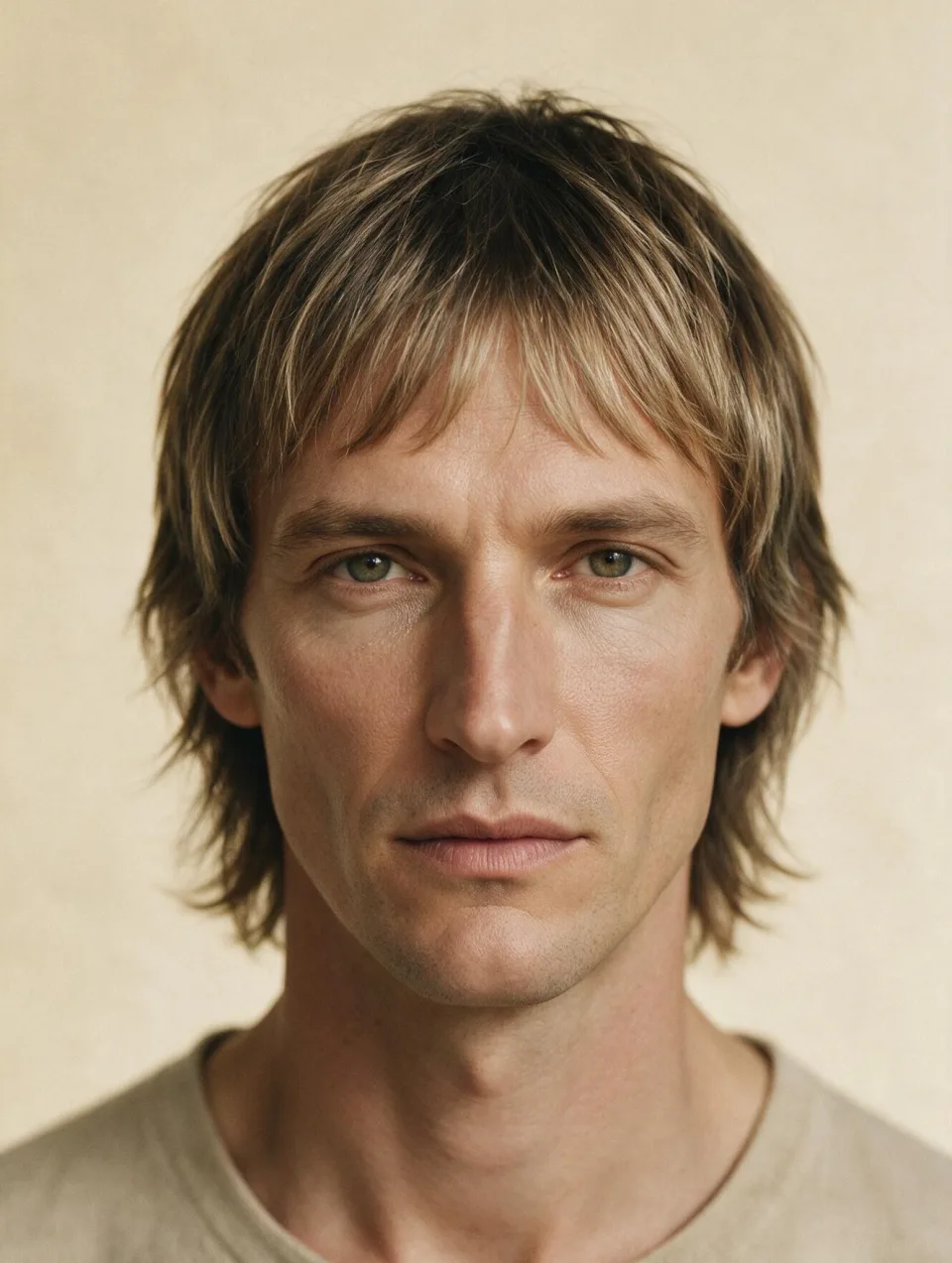
An oblong face is the one shape whose haircuts optimize for shorter, not sharper: it already runs long, with forehead, cheekbones and jaw close to the same width, so its cuts add width at the sides and stop adding height at the crown. Waves, side volume and a fringe all shorten the visible face length; a blunt or curtain bang covers forehead height directly. The style to avoid is long, straight, flat hair with no volume, which drags the eye further down an already long axis. The full list is in haircuts and hairstyles for an oblong face.

Triangle: Add Width Up Top
A triangle face is the heart shape inverted: the jaw measures widest and the forehead narrowest, so its haircuts add width and volume at the temples and crown while keeping weight off the jawline. Volume in the top layers, or a side-swept fringe with lift at the temples, widens the upper third to meet the jaw's measurement. The cut to avoid is a chin-length bob, which stacks its weight exactly at the widest span on the face. The named cuts for both men and women are in haircuts and hairstyles for a triangle face.
Detect Your Face Shape First
Every rule above assumes you know which of the seven shapes you are measuring from, and that is the step most people skip. The free face shape detector runs the same four-span comparison automatically: its AI facial analysis maps landmarks on a front-facing photo, measures forehead, cheekbone and jaw width against face length, and prints the class plus the margin to the next closest one. The scan runs entirely on your device, and your photos never leave your browser. A mirror and a tape measure work too; the detector just removes the tilt and estimation errors that push borderline faces into the wrong class.
What a Haircut Cannot Change
A haircut changes how your proportions read, not the proportions themselves: the four measurements that sort your face into a shape class are still there under any cut. Just as importantly, face shape carries no attractiveness ranking. No shape on this page scores higher than another, and a stylist who treats one as a problem to fix is selling correction the geometry never asked for. Symmetry and proportion are a separate measurement entirely: the free attractiveness test scores those, and your Attractiveness Report ranks what actually moved the number. Either way, a score is a starting line, not a verdict.
Not medical advice. This page describes a styling convention built on facial geometry, not a diagnosis, a clinical assessment or a verdict on you.