Rate My Face: Free AI Face Rating and Beauty Score
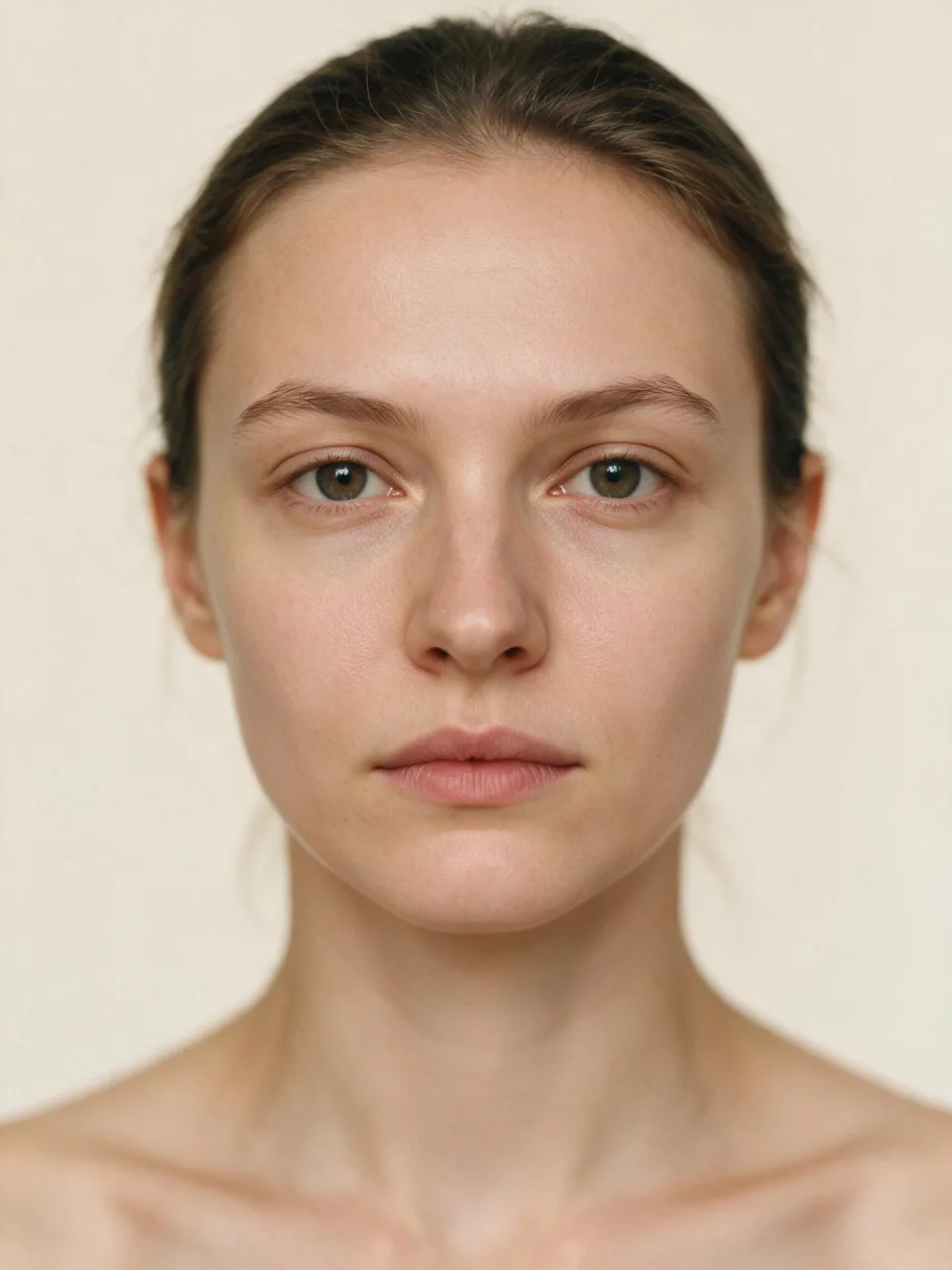
EXAMPLE ANALYSIS: 478 LANDMARKS MAPPED ON A SAMPLE PHOTO, NOT YOURS.
What a reading looks like
Real components · sample dataA starting line, not a verdict.
What we won't show you: a confidence band (not until our test-retest study ships) · a percentile (not until a reference population is published) · a skin score from one photo (lighting lies). Every "not scored" comes with its reason.
A face rating is an attractiveness score expressed out of 10; the beauty score shown here is the same measurement rendered on a 0-100 scale. It returns a rating in about ten seconds. It's free, with no photo upload.
The Short Version

How Do I Rate My Face for Free?
You can rate your face for free in this browser. No account, no install and no upload: the measurement runs on your device and returns a number in about ten seconds.
The only cost is a usable photo: a clear, forward-facing shot in even light, so the on-device measurement has something to read. Nothing you rate leaves your browser, because there is no upload step, and nothing about the scan asks for a credit card, an email address, or a trial that quietly turns into a subscription. Rating your face this way returns the same 478-landmark measurement an app or a paid service runs, at no cost, because the computation runs on the device you are already holding.
How Do I Rate My Own Face Without an App?
You can rate your own face without an app because the same 478-landmark measurement an app performs after an install runs in a web page you already have open.
Face-rating apps typically ask for three things before they show you a single number.
- An install, before the camera even opens.
- An account, tied to an email address or a phone number.
- A photo, uploaded off the device to a server you cannot inspect.
The one honest advantage an app keeps is offline use: a browser tool needs a page to load once, while a native app keeps working with no connection at all. For a single face rating, that trade rarely matters, because the page you are already on is running the same measurement without asking for anything first.
What a Face Rating Measures: Symmetry, Proportions, Harmony
This rating measures symmetry, facial thirds and fifths, and facial harmony from 478 landmarks detected in your browser. Symmetry compares paired points across a fitted midline. Facial thirds and fifths check whether the face divides into even vertical and horizontal sections. Harmony checks whether those measurements agree with each other, rather than one feature carrying the score. This rating does not measure skin quality, your side profile or averageness, because each needs a different kind of photo or a published reference set this tool does not yet have. The full component breakdown, with every weight disclosed, lives on the attractiveness test behind the rating.
Your Face Rating, in Plain Numbers
Your face rating is a 1-10 value with one decimal, computed from the components measured on one photo.
A rating states how one photo's components combine under the published weights. A percentile states how that value ranks among other people, which needs a stated reference population and its size. A confidence band states how far one face's rating moves between photos, which needs a test-retest study. Neither of the last two exists yet at a standard worth printing, so the card shows the rating alone and says why.
| The number | What it states | Status right now |
|---|---|---|
| Rating, 1-10 | How your photo's components combine under the published weights | Printed on every result |
| Percentile | Where that rating ranks in a stated reference population | Withheld until the population and its size are published |
| Confidence band | How far one face's rating moves across photos | Withheld until the test-retest study is run |
A percentile without a named population is decoration, so both rows stay blank until they are real numbers, not placeholders.
Rate My Photo, My Picture, My Looks: One Tool, Every Phrasing
Rate my photo, rate my picture and rate my looks are the same request in different words, and this tool answers all of them with one measurement. Say rate my pic or rate my image instead, and the scan still reads facial geometry, not the word you used for the file. Rate my appearance and rate my beauty name the identical target: whichever phrase you typed, a face rater, a looks rater and a beauty rater are three names for this same 1-10 measurement. The more useful version of the question is plural: rate my photos. Add up to three photos of the same face, and the tool rates each one and states the spread between the highest and the lowest, in points. That spread shows something a single photo cannot: how much of a rating belongs to the camera rather than to the face. The same face might rate 6.8 in one photo and 5.6 in another; it has not changed. The light, the distance or the angle has. Rating three of your own photos is the simplest way to see that for yourself, before trusting any single number as the whole story.
What Is the Best Face Rater?
The table compares five ways to get a face rating today, evaluated on the same criteria.
The best face rater discloses its formula, keeps your photo on your device, and names a photo it cannot measure instead of guessing.
| Tool type | What it measures | Scale | Publishes its formula? | What happens to your photo | Price |
|---|---|---|---|---|---|
| Browser-based raters | Facial geometry from an uploaded photo | Usually 1-10 or 0-100 | Rarely | Uploaded to a server, retention varies | Free to about $10 a month |
| App-store raters | Facial geometry, after an install | Usually 0-100 | Rarely | Uploaded, often with an account required | Free with ads, or a subscription |
| Chatbot prompting | A written description of the image | No fixed scale | No | Sent to the provider's own servers | Free to a paid plan |
| Human raters (forums, panels) | A person's opinion of one photo | Whatever scale the group picked | Never | Posted publicly, in most cases | Free, but public |
| This tool | 478 on-device landmarks | 1-10, with a 0-100 render | Yes, weights published | Never uploaded, in either mode | Free |
Human raters can be faster to reach, and a subscription app may add features this tool does not. No single row wins every column, and an honest comparison says so instead of picking a winner.
Is a Beauty Score the Same as a Face Rating?
A beauty score and a face rating are the same measurement on two scales: 6.4 out of 10 is 64 out of 100, because the second number is the first one multiplied by ten.
Face rating, beauty score, face score and looks rating are four names attached to one measurement, and this instrument reports it once and labels it four ways. The registers differ; the geometry underneath does not.
- Face rating: the imperative phrasing, and the label this page uses first.
- Beauty score: the 0-100 register other tools publish, the same value switched.
- Face score: a shorter form of the same rating, used interchangeably.
- Looks rating: the same measurement, described as a judgment of looks rather than of a face.
What the shared arithmetic does not mean: a 64 measured here is not a 64 measured somewhere else, because the formula behind it and the population it is compared against are both different. Converting a number to a second scale is not the same as converting it to a second tool.
Is the Face Rater Accurate?
The face rater is reproducible: the same photo and the same score version return the same number, to the decimal, on any device.
Reproducible is a narrower claim than accurate. Accurate would mean the number matches how a room full of people would actually rate your face, and that needs a rater study this tool has not run. What it defends instead is narrower and real: the method is disclosed, the weights are published, the score version is stamped on your result, and a photo that fails the validity gate returns a named reason rather than a guessed number. Three things move the number between runs: the photo's own conditions, a change in the score version, and a change in the reference population once one is published. The statistics behind reproducibility, and where the method is known to fail, live in how we measure attractiveness.
What the Evidence Says About Face Ratings
Independent raters agree about facial attractiveness more than chance, and less than completely. Langlois and colleagues, reviewing 11 meta-analyses in Psychological Bulletin in 2000, found raters agree with each other on facial attractiveness at about r = 0.90 within a culture [1]. What that does not license: treating one face rating as a claim about universal consensus. Agreement weakens across cultural lines: Coetzee and colleagues, in PLOS ONE in 2014, had African and Scottish observers rate the same 179 faces and found the correlation fall to r = 0.49 on African faces against r = 0.75 on Scottish faces [2], so a rating trained on one population is a narrower claim than attractive to everyone.
Photographs of one face vary enough to move a rating on their own. Jenkins, White, Van Montfort and Burton, in Cognition in 2011, asked untrained viewers to sort 40 photographs of two unfamiliar people by identity and found a median of 7.5 identity clusters, instead of two, from photo variation alone [3]. What that does not license: assuming a rating that moved between two photos of you is wrong. It licenses the opposite conclusion: the photo-set mode above measures that same effect on your own face, on purpose.
Geometric measurements predict average attractiveness ratings well, at the population level. Pallett, Link and Lee, in Vision Research in 2010, fit facial ratios such as eye-to-mouth distance against rated attractiveness across four experiments and explained as much as 83% of the variance in average ratings [4]. What that does not license: predicting one individual's personal taste from geometry alone. The model fits the average of many raters, and Hönekopp's finding that personal taste accounts for roughly half the variance in how any one rater scores a single face still applies underneath it [5].
What This Score Cannot Tell You
This rating measures one photo against one aesthetic tradition, and six limits bound everything above.
None of that makes the rating worthless. It makes the rating a starting line, not a verdict.
That is the complete account of the instrument. The rest of this page is about the number you are holding.
What Is a Score Out of 10 Actually Measuring?
A score out of 10 places one photo's measured geometry against a reference distribution, and the band it falls into means the same thing on every page of this site. Locating the number, checking it, and knowing what actually moves it are the three things worth doing next, in that order.
Where your rating sits on the 1-10 scale
A 7 out of 10 is above average on this scale. It sits above the midpoint, in the band where most measured components land near or above balance, and it describes a photo's geometry rather than a person.
The bands are fixed site-wide, so a 7 here carries the same meaning as a 7 on every other instrument on this site, and none of them carries a tier name. The full ladder, and the research behind each boundary, is in what your face rating means on the 1-10 scale.
How to check the rating you just got
Confirming your own rating takes three steps and about two minutes.
- Retake the photo with the rear camera at arm's length, head straight on, in even light.
- Rate the new photo on the same score version.
- Read the gap between the two numbers as photo variation, not as a change in your face.
Two photos of one face rarely return the identical number, and that gap is a fact about the photos, not about two faces. Stating how large the gap has to be before it counts as real needs a test-retest study, which has not been run, so this version prints no threshold rather than inventing one.
What moves a face rating
Three tiers move a measured rating, ranked by evidence rather than by how loudly each is sold.
- Immediate and measured: photo conditions. Camera distance, angle and lighting move a rating inside a single session, and your own photo set just showed you by how much.
- Moderate and real: grooming, sleep and styling. A rested face and a change to hair or brows shift harmony and apparent proportion over weeks.
- No measurable effect: bone-remodeling claims. Mewing, jaw exercises and chewing devices do not reshape adult facial bone.
Every one of those tiers is one line item inside a bigger measurement. The full ranking, worked against your own face rather than a general list, sits inside the full AI face analysis.
See every measurement in your Attractiveness Report: it adds your side profile, ranks which measurements moved your number, and re-scores you on day 30 against the same formula version.
If You Asked a Different Question
The full attractiveness test asks this question without the first person: every component this rating uses, plus side-profile weighting and averageness, on one photo, with every weight published. It is the longest treatment of the method on this site.
Am I pretty asks the same measurement from a question instead of an instruction, framed for someone checking rather than someone rating. It is the version to open if what you want is reassurance about a specific worry, not a number to keep.
The 1-10 scale guide explains what a given number means, band by band, across every tool on this site. Interpretation lives there; measurement lives here.
The Pretty Scale page covers the 2013 tool that still ranks for face-rating searches, and where its method parts ways with a 478-point landmark mesh.
You have a rating now, and the three tiers that move it. The report ranks your own measurements, hands you the order to work in, and re-scores you on day 30 against the same formula version.
Not medical advice. This is a measurement of a photo, not a diagnosis, a clinical assessment, or a verdict on you.
It measures geometry, not worth. The number tells you where you start. It never tells you what you are.
on every page
of this site
Your report, in full.
- Side profile
- Skin, measured properly
- Averageness
- Dimorphism
- Ranked plan
Paid photo deleted within 24 hours · never used for training
- 40+ measurements, 7 regionsPP. 2-9
- Side profile, from a second photoPP. 10-13
- What moved your score, rankedPP. 14-16
- Four week plan and day 30 re-scanPP. 17-20
Frequently Asked Questions
Is there an app that rates your looks?
Yes, several apps rate your looks, and most of them ask for an install and an account before showing a number. The one advantage an app keeps over a browser tool is working without an internet connection.
What is my beauty score?
Your beauty score is the same rating this tool gives out of 10, shown instead on a 0-100 scale. Switch the scale inside your result to see both numbers for the one measurement.
Can I rate my side profile too?
Not in this rating: a side profile needs a second photo, so it is one of the states this tool marks as not scored. A dedicated side-profile tool is coming, and the side profile is already measured inside the full Attractiveness Report.
Is a ChatGPT face rating the same thing?
No: a chatbot describes what it sees in an image rather than measuring landmarks, so its answer is not reproducible between attempts. See a ChatGPT face rating, tested for what happened when we asked one directly.
What is a "brutally honest" face rating?
A measurement has no tone, so the real question is whether a tool prints a verdict on top of its number, and this one does not. "Brutally honest" describes a sales style some sites use; a rating that states its method and its limits does not need one.
How many photos should I rate?
Rate up to three photos of the same face, and read the spread between the highest and lowest rating rather than chasing the highest one. A small spread is photo variation. The confidence band that would set the exact threshold stays withheld until the test-retest study runs.
Why is my face rating different on another site?
Different sites use different formulas, different scales and different reference populations, so a 64 on one site is not a 64 on another. Neither number corrects the other; they are simply not the same measurement.
Can I rate someone else's face?
The tool measures whatever single photo you give it and does not compare two people or rank a group, and nothing you rate is published anywhere. Ask before you use a photo of someone else's face.
Do I need to sign up to rate my face?
No: rating your face needs no account, no email and no install, and no photo is ever uploaded from your device. The scan runs entirely in your browser, the same way the privacy page describes.
References
Every claim above, traceable
- Langlois, Kalakanis, Rubenstein, Larson, Hallam and Smoot, Psychological Bulletin 2000 - meta-analytic review across 11 meta-analyses: raters agree about facial attractiveness at about r = 0.90 within a culture.
- Coetzee et al., PLOS ONE 2014 - African and Scottish observers rating the same 179 faces agreed at r = 0.62 overall, r = 0.75 on Scottish faces and r = 0.49 on African faces.
- Jenkins, White, Van Montfort and Burton, Cognition 2011 - untrained viewers sorting 40 photographs of two unfamiliar people by identity produced a median of 7.5 identity clusters instead of two.
- Pallett, Link and Lee, Vision Research 2010 - facial ratios such as eye-to-mouth distance explained up to 83 percent of the variance in average attractiveness ratings across four experiments (R2 = 0.83).
- Honekopp, Journal of Experimental Psychology: Human Perception and Performance 2006 - private taste accounts for roughly half the variance in facial attractiveness ratings.
- Buolamwini and Gebru, PMLR 2018 - commercial face classifiers showed error rates up to 34.7% for darker-skinned women against 0.8% for lighter-skinned men.
- Grother, Ngan and Hanaoka, NIST IR 8280, 2019 - face recognition false-match rates ran 10 to 100 times higher for some demographic groups.