AI Nose Shape Detector: What Is My Nose Shape?

EXAMPLE ANALYSIS: 478 LANDMARKS MAPPED ON A SAMPLE PHOTO, NOT YOURS.
What a reading looks like
Real components · sample dataA starting line, not a verdict.
What we won't show you: a confidence band (not until our test-retest study ships) · a percentile (not until a reference population is published) · a skin score from one photo (lighting lies). Every "not scored" comes with its reason.
Nose shape is read from three measurements: dorsal profile (straight, convex or concave), tip rotation, and alar width relative to intercanthal distance. Every named nose type is a combination of those three readings.
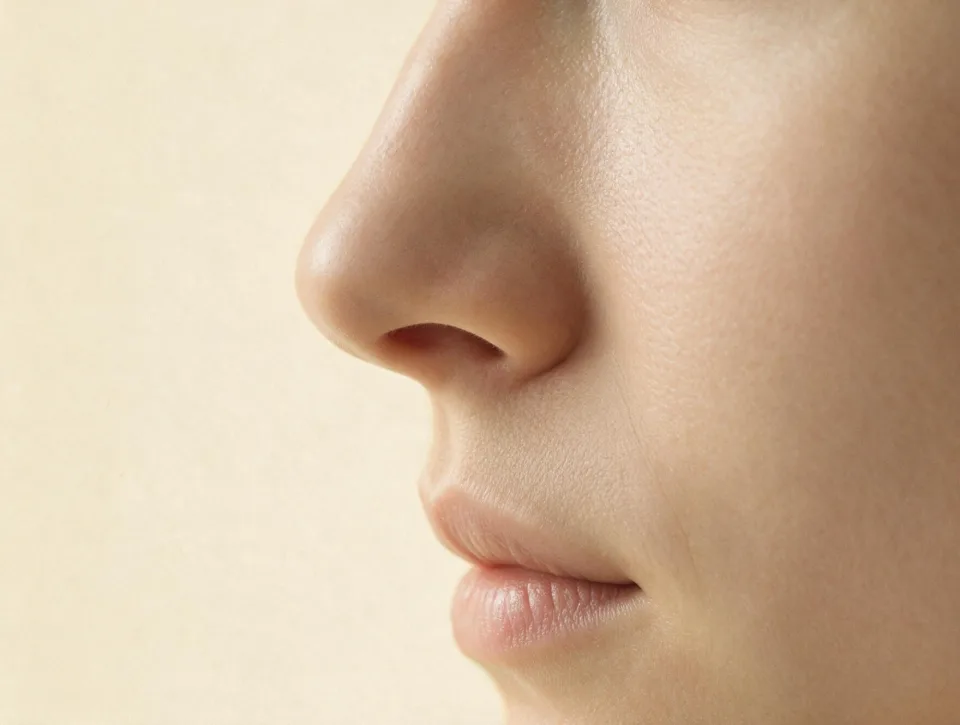
This page is the AI facial analysis answer to a folk-chart question: it defines the three measurements behind every named nose type, gives you the self-check rules to classify your own nose, and says plainly what the free on-device scan measures today. The scan scores symmetry, facial thirds, facial fifths, golden ratio proximity, and harmony; it does not print a nose class, and this page will not pretend it does.
The Short Version
What Is a Nose Shape?
A nose shape is the combination of three measurable readings: the bridge line seen from the side, how far the tip rotates upward, and how wide the nostril base sits against the space between your eyes.
A nose shape is a combination of measurements, not a single trait: the dorsal profile (the bridge line from the root of your nose to the tip, seen from the side), the tip rotation (how far the tip angles upward, read at the angle between the columella and the upper lip), and the alar width (the widest span of the nostril wings, compared against the distance between your inner eye corners). Folk charts compress those readings into named types: Roman and aquiline describe a convex bridge, Greek describes a straight one, snub and button describe a rotated tip on a shorter nose. Most nose-type charts online name twenty types and measure none of them; the three readings are the part you can actually check.
How Your Nose Shape Is Measured: Three Readings
The measurement convention comes from the facial-analysis literature, which reads the nose with named angles and ratios rather than type names [3]. The dorsal profile is classified from the side as straight, convex, or concave, depending on whether the bridge line runs flat, bows outward into a hump, or dips inward. Tip rotation is read at the nasolabial angle, the angle between the columella (the strip of tissue between your nostrils) and the upper lip: the wider the angle, the more upturned the tip [3]. Alar width is read front-on as the span between the outer edges of the nostril wings, and the classical reference compares it with the intercanthal distance, the space between your inner eye corners [2]. Each reading is independent: a straight bridge can sit above a wide base, and a narrow nose can carry a dropped tip.
- Take a true side-on photo at eye level, hair off the bridge. Follow the bridge line from between your eyes to the tip: flat reads straight, an outward bow reads convex, an inward dip reads concave.
- In the same photo, look at the angle between the base of your nose and your upper lip: open well past a right angle reads as an upturned tip, near a right angle reads as straight, tighter reads as a dropped tip.
- Take a straight-on photo with a relaxed expression. Compare the widest span of your nostril wings with the distance between your inner eye corners: narrower, about equal, or wider.
- Combine the three readings. Straight bridge, upturned tip, narrower base is one nose; convex bridge, straight tip, wider base is another. The chart below names the common combinations.
The live scan on this page runs none of those three readings as a classifier, and saying so plainly is the point of this site. It fits 478 landmarks in your browser and scores five geometry components (symmetry, facial thirds, facial fifths, golden ratio proximity, and harmony) against published weights, and photos never leave your browser while it runs. Your nose sits inside two of those components: the thirds reading splits your face at the base of the nose, and the middle segment of the fifths reading is your intercanthal distance, the same reference the width canon uses. A dorsal profile needs a side photo, which a front-facing scan cannot see.
Straight, Convex, or Concave: The Nose Shape Chart
| Reading | Classes | How to check it | Folk names it feeds |
|---|---|---|---|
| Dorsal profile | Straight, convex, or concave | The bridge line in a true side-on photo | Greek (straight), Roman or aquiline (convex), ski-slope (concave) |
| Tip rotation | Upturned, straight, or dropped | The angle between the columella and the upper lip, same side photo | Snub and button (upturned), hawk (convex bridge with a dropped tip) |
| Alar width | Narrower, equal, or wider than intercanthal distance | Nostril-wing span against inner-eye-corner distance, front-on | Most width labels; many are ethnic labels this page does not use as categories |
The three-class dorsal convention is the one the research literature actually uses. A systematic review of nasal profile analysis methods classifies the dorsum as straight, convex, or concave, and a 123-woman study inside it found a straight dorsum most prevalent with skeletal class I bites, a convex dorsum (a hump) with class II, and a concave dorsum with class III [3]. The same review carries the growth finding behind most teenage hump stories: after about age 14 the tip stops moving forward as much as the nasal bones do, which is when a bridge that read straight in childhood can start to read convex [3]. Nose shape keeps moving after growth too, just slowly: nasal length and depth correlate strongly with age [3].
What the Evidence Says About Nose Width
The evidence says the textbook width rule fails for most measured faces. The neoclassical canon behind the fifths grid claims the nose is exactly as wide as the space between your eyes, and when a study measured that claim directly in young adults from the Arabian Peninsula, the most common finding was a nose wider than the intercanthal distance: 92 percent of the men and 56 percent of the women measured [2]. A wider-than-canon nose is the ordinary result, not the exception, and the study's comparisons across published samples found the proportion differs sharply between populations [2].
Population variation in nose width is not noise; it is history. A PLOS Genetics study measured nose shape across populations and found the width of the nares more differentiated between populations than genetic drift alone predicts, and correlated with temperature and absolute humidity [1]. Width partly tracks the climates a population's ancestors lived in. That is the honest frame for every width reading on this page: a description with a history behind it, never a defect.
What the Free Scan Measures (and What the Report Adds)
The free scan measures five geometry components and returns your attractiveness score from them: symmetry, facial thirds, facial fifths, golden ratio proximity, and harmony, each at a published weight. It shows the segment values behind the fifths grid, so you can see the intercanthal reference for yourself. What it will not do is print a type name over your face: the dorsal reading a type name needs lives in a view the front scan cannot see.
The missing view has a home. The paid report includes a side-profile measurement, taken from a second photo, which reads the profile line the dorsal classes describe. What ships in it, and what it costs, is stated once, further down this page.
Your Nose and the Rest of Your Face
The side profile is the nose's home view, and it has its own instrument: the side profile rating explains the convexity angle the profile line is scored by, the same view where your dorsal class lives. If your question is about the bridge or the tip, that page is the sibling to read next.
The lower face carries the other two siblings. Your lip shape is read from ratios just below your nose, and the jawline rating measures the angle that frames them both. For every measurement in one pass, the full face analysis reports each component with its own unit and tolerance instead of one blended number.
Can You Change Your Nose Shape?
No exercise, tool, or routine changes the shape of your nose. The dorsal profile and the alar base are cartilage and bone, and neither tissue remodels because a face is exercised at it; makeup contouring changes how a nose photographs, not its geometry. What does move the readings, slowly, is time: growth reshapes the dorsum through the teens, and nasal length and depth track age after it [3]. One boundary sentence, stated once: anything surgical is a medical decision for a qualified specialist who examines you in person, and this page carries zero surgical content by design. The wider family of appearance claims, graded by evidence strength, lives in the looksmaxxing guide.
What This Score Cannot Tell You
This page returns measurements and a self-check, not a verdict, and the limits below are fixed.
Where Your Nose Fits in the Full Analysis
The nose sits at the crossing point of the two proportion grids the scan scores. Vertically, the base of your nose is the boundary the thirds reading splits your face at; horizontally, the intercanthal segment at the center of the fifths grid is the canon reference for alar width. Move the nose readings and both grids move, which is why the composite treats your attractiveness score as one system rather than a nose graded alone. The exact landmarks, weights, tolerances, and version tags are public on the methodology page, fixed before this page went live.
Not medical advice. This is a measurement of a photo, not a diagnosis, a clinical assessment, or a verdict on you.
It measures geometry, not worth. The number tells you where you start. It never tells you what you are.
on every page
of this site
Your report, in full.
- Side profile
- Skin, measured properly
- Averageness
- Dimorphism
- Ranked plan
Paid photo deleted within 24 hours · never used for training
- 40+ measurements, 7 regionsPP. 2-9
- Side profile, from a second photoPP. 10-13
- What moved your score, rankedPP. 14-16
- Four week plan and day 30 re-scanPP. 17-20
Frequently Asked Questions
What is my nose shape?
Your nose shape is the combination of three readings: dorsal profile (straight, convex, or concave), tip rotation (upturned, straight, or dropped), and alar width against your intercanthal distance. The self-check on this page sorts all three with a mirror and two photos.
What are the main nose shapes?
The research convention classifies the dorsal profile as straight, convex, or concave, then adds tip rotation and width readings [3]. Folk charts name ten or twenty types, and every one of them is a combination of those three measurements.
Can AI detect my nose shape from a photo?
A landmark model can measure width and proportion from a front photo, and the dorsal profile needs a side photo. The free scan here scores five geometry components on your device and does not print a nose class; this page gives you the classification rules instead.
Is a wide nose normal?
Yes. When the width canon was measured directly, a nose wider than the intercanthal distance was the most common result, found in 92 percent of the men in the measured sample [2], and cross-population work ties width differences to climate history rather than to any defect [1].
Which nose shape is most attractive?
No published method defensibly ranks nose classes by attractiveness, and this page does not either. A class is a description; how a whole face reads depends on the proportions between features, which is what the scored scan actually measures.
Does your nose keep changing with age?
Yes, slowly. Growth studies in the nasal-profile literature report that after about age 14 the tip stops moving forward as much as the nasal bones, which can turn a straight childhood bridge convex, and nasal length and depth correlate strongly with age [3].
Can I change my nose shape without surgery?
No. The dorsal profile and the alar base are cartilage and bone, and neither remodels because a face is exercised at it. Makeup changes how a nose photographs; the geometry stays. Anything surgical is a question for a qualified specialist, not a photo tool.
Does the nose shape scan upload my photo?
No. The landmark mesh runs inside your browser and no image bytes are transmitted while you measure; open the network tab and watch. The details live on the privacy page.
What is the difference between nose shape and nose size?
Shape is the combination of profile, rotation, and relative width; size is absolute dimension, which scales with head size and lens distance. Every reading on this page is relative, which is why a photo can measure it at all.
References
Every claim above, traceable
- Zaidi AA, Mattern BC, Claes P, McEvoy B, Hughes C, Shriver MD, PLOS Genetics 2017 - nares width is more differentiated across populations than genetic drift alone predicts and correlates with temperature and absolute humidity, evidence of climate adaptation in nose width.
- Al-Sebaei MO, Head and Face Medicine 2015 - validity study of three neoclassical facial canons in young adults from the Arabian Peninsula; the most frequent orbito-nasal result was a nasal width wider than the intercanthal distance, in 92 percent of males and 56 percent of females.
- Jankowska A, Janiszewska-Olszowska J, Jedlinski M, Grocholewicz K, BioMed Research International 2021 - systematic review with meta-analysis of nasal profile analysis methods; dorsum classified as straight, convex, or concave, nasolabial angle defined at the columella and upper lip, and nasal length and depth strongly correlated with age.