Most jawline exercises do not sharpen a jawline. Definition comes mostly from body fat and bone, and adult bone does not remodel from tongue posture or chewing. Every route below is graded by evidence.
The Short Version
What Actually Makes a Jawline Look Sharp
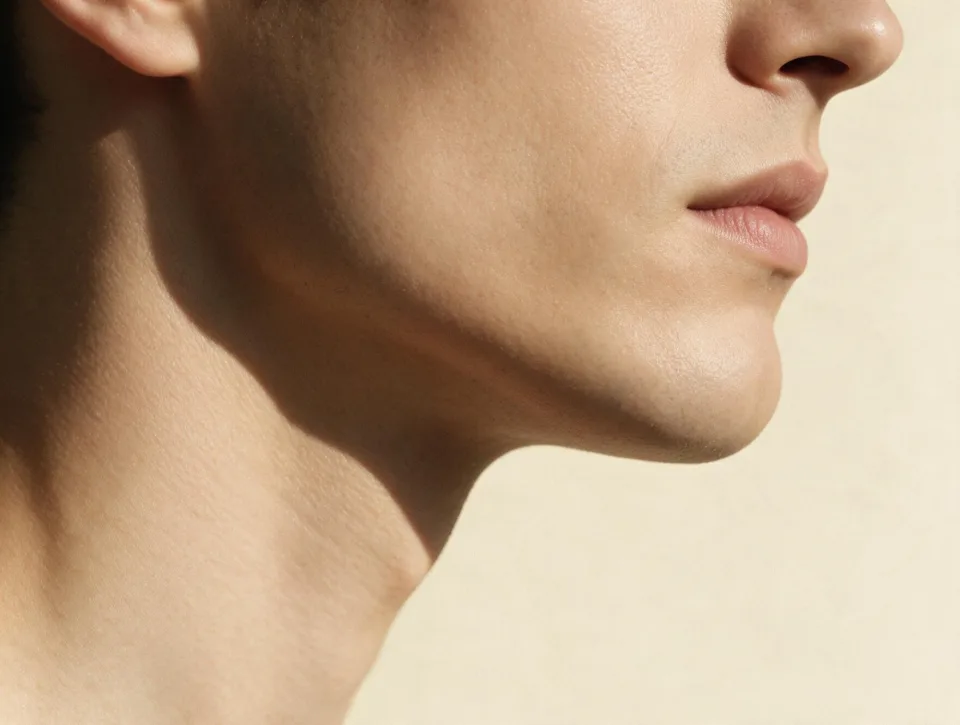
A sharp jawline is a visible mandibular border: low fat under the chin, skin that follows the bone, and the bone itself. Muscle contributes width at the jaw's angle, not sharpness along the border.
Jawline definition is set by three tissues: the mandible, the fat layered over it, and the skin that drapes both. The bone fixes the shape, the fat decides how much of that shape shows, and skin quality decides how cleanly the edge reads. Muscle enters the picture only at the back corner of the jaw, where the masseter sits. The jawline-exercise industry trains the one tissue of the three that was never the bottleneck.
Every route below carries one of the same four evidence grades this site uses everywhere. Strong means a controlled trial tested the change directly. Moderate means the effect is real and quantified but comes from smaller or observational work. Styling heuristic means practice supports it, not peer-reviewed research. Contested-none means no reliable evidence supports the claim, and the grade is printed rather than softened. That is what the evidence says, route by route.
Every Route, Graded: The Evidence Table
| Route | Evidence Grade | What It Changes | How Fast | Citation |
|---|---|---|---|---|
| Mewing (tongue posture) | Contested-none | Nothing measurable in the adult mandible | Not applicable | [1][2] |
| Chewing gum and hard chewing | Contested-none | Bite force rises; muscle thickness and jaw shape do not | Not applicable | [3][4] |
| Jaw exerciser devices | Contested-none | No trials on definition; joint-load concern is documented | Not applicable | [5] |
| Facial exercises | Contested-none | Studied for aging appearance, never for jawline definition | Not applicable | [6] |
| Body-fat change | Moderate | The fat layer over the border and under the chin | Weeks to months | [7] |
| Posture and camera angle | Styling heuristic | How the jawline reads in a photo | Immediate | Heuristic, no trial |
Mewing: Adult Bone Does Not Remodel From Tongue Posture
Mewing does not sharpen an adult jawline, because adult bone does not remodel from tongue posture. The claim borrows its vocabulary from orofacial myofunctional therapy, a real clinical field, so the honest test is what that field's own evidence shows. A 2025 scoping review in the European Journal of Orthodontics found 24 studies on the therapy, only four of them randomized controlled trials, with no comparison reaching the top level of evidence [1]. Those studies also target bite problems and post-surgical function, mostly in children, not the adult bone remodeling the trend claims.
The surgical community has noticed the gap between claim and evidence. A commentary in the Journal of Oral and Maxillofacial Surgery flagged mewing as social media's self-administered alternative to orthognathic surgery, a framing surgeons now field from patients directly [2]. Grade: Contested-none. What it changes: nothing measurable in the adult mandible. The cost is not injury; it is months spent pressing a tongue against a palate instead of doing anything on this page's one Moderate row.
Chewing Gum and Hard Chewing
Chewing trains the masseter, the jaw's main closing muscle, and the best trial found it changes function rather than shape. A randomized controlled trial in the Journal of Oral Rehabilitation had 58 healthy adults chew gum three times a day for six months: maximum bite force rose, while masseter thickness and mandibular shape did not change [3]. The firmness people feel after a long chew session is real but temporary. Masseter thickness rises 8.6 to 14 percent immediately after chewing and clenching exercise and returns to baseline within about 20 minutes, because it is swelling, not growth [4].
Grade: Contested-none for definition. Even where the masseter does enlarge, the change lands at the angle of the jaw as width, which is the opposite of the sharpness most people are chasing. The whole claim gets its own page: does chewing gum help your jawline, checked mechanism by mechanism.
Jaw Exercisers
Jaw exerciser devices have no published trials measuring a change in jawline definition, so the only honest grade is Contested-none. The silicone and spring devices sell resistance chewing, which is the gum mechanism at a higher load, and the load is the documented part. In a study of 323 adolescent girls, intensive chewing of more than four hours a day was associated with jaw-joint noises and pain in the ear area [5]. A device that makes the joint click or ache is producing data, and the correct response to that data is to stop. Anyone with existing jaw-joint symptoms should skip this category entirely.
Facial Exercises
Facial exercises have never been tested against jawline definition. The most frequently cited study is a 20-week pilot in middle-aged women, published in JAMA Dermatology, and it measured the appearance of facial aging, not jaw shape [6]. A small pilot on a different question is not evidence for this one, so the grade stays Contested-none. If a routine of cheek lifts feels good, nothing here argues against it; this page only refuses to promise it a jawline.
Body-Fat Change: The One Route That Moves
Body-fat change is the one route on this page with a real mechanism and real evidence, because facial fat sits directly over the mandibular border. Lower it and the same bone shows more cleanly; nothing new is built. The research backs the perceptual half of that claim: facial adiposity significantly predicts how healthy and how attractive a face is rated [7]. Grade: Moderate. How fast: weeks to months, and where the face leans out first is genetic, so the timeline is not negotiable by effort alone.
Two boundaries, stated plainly. This applies within a healthy weight range, and a face is not a reason to leave one. If eating and appearance have started steering each other, the National Alliance for Eating Disorders runs a free helpline answered by clinicians, and it takes calls about body image generally. A jawline is geometry, not worth.
Posture and the Camera
Posture changes how a jawline reads, not what it is. Pushing the chin slightly forward and down, the trick photographers have used for decades, tightens the area under the chin in a photo instantly and for free. No trial ties posture training to a measured change in definition, so the grade is Styling heuristic, the same label this site puts on every practice-supported, research-thin claim. It is also the only route on this page that works in the next five minutes.
How Would You Know It Worked? Measure, Then Re-Measure
You would know it worked by measuring the same jaw the same way twice, which is what the free scan on this site is for. Start with a baseline: rate your jawline before and after any change you commit to. The scan runs AI facial analysis across 478 landmarks in your browser, and photos never leave your browser; it is the same on-device engine that builds your Attractiveness Report. Re-scan in the same light, at the same distance, with the same expression, or the comparison measures your camera. Every measurement is defined in the methodology.
A jawline number is one component of an attractiveness score, never a verdict on a person. About half of how any single rater judges a face is private taste no measurement reaches, and nothing on this page changes how anyone who already knows you sees you.
Every graded claim above traces to a named, peer-reviewed source below, numbered in order of first appearance. Where a route has no source strong enough to name, this page prints Contested-none instead of borrowing confidence. The evidence-ranked version of the whole-face question lives at how to get a prettier face, and the vocabulary around this subculture is mapped in what is looksmaxxing.
Not medical advice. This page grades non-surgical claims by evidence; it is not a diagnosis, a treatment plan, or a substitute for a dentist, physician, or mental health professional.