Eyeliner lifts a negative canthal tilt by keeping the line thin until the outer third, then angling the wing upward past the outer corner. It changes how the tilt reads in a mirror or photo, not the angle itself.
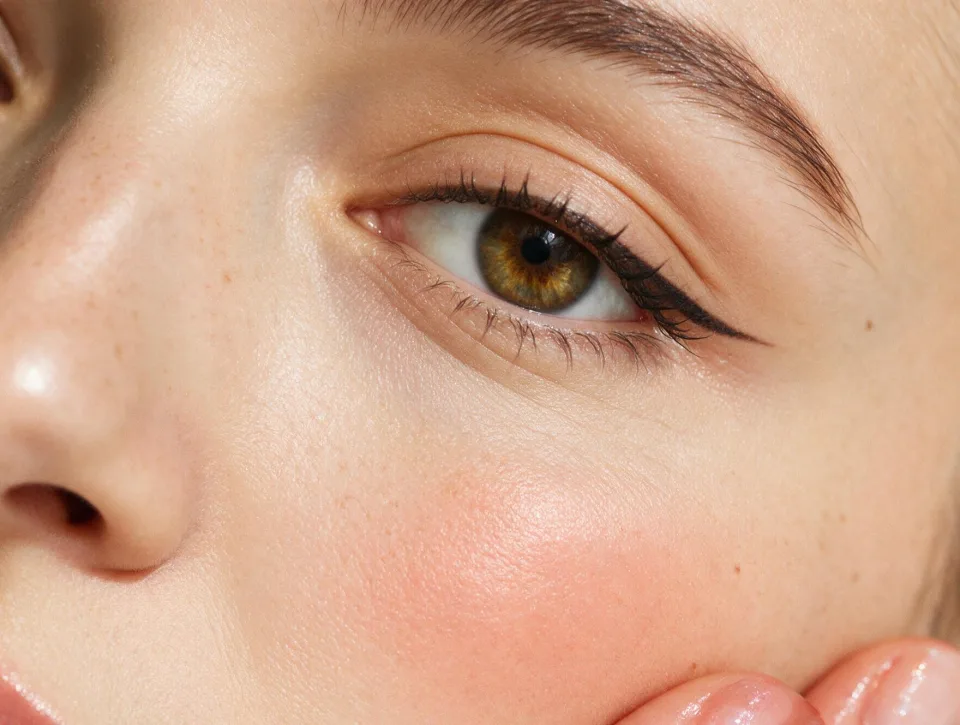
This guide covers both directions: the liner that lifts a negative canthal tilt and the liner that balances a strong positive one, in steps you can follow at a mirror. Before you pick a technique, measure your actual canthal tilt: the free scan reads it per eye, in degrees, on your device.
The Short Version
First, Know Which Tilt You Have
Canthal tilt is the angle between the inner and outer corner of your eye, read against a horizontal fitted to your face: positive means the outer corner sits higher, negative means it sits lower, neutral means the two are level. Published adult averages run from under 1 degree to about 8 degrees of upward tilt depending on the population measured, and most means sit above zero. The free AI facial analysis behind this guide measures yours per eye, in degrees, entirely on-device: photos never leave your browser. The number matters here because the two techniques below run in opposite directions, and near zero the honest answer is that you need neither.
| Tilt class | Where the outer corner sits | Typical reading | The liner job |
|---|---|---|---|
| Positive canthal tilt | Higher than the inner corner | Above 0; most published adult means sit here | Leave the lift alone; add level weight if it reads strong |
| Negative canthal tilt | Lower than the inner corner | Below 0 | Thin start, wing angled upward from the outer third |
| Neutral canthal tilt | Level with the inner corner | At or near 0; camera height alone can flip the sign | Whatever you like; there is nothing to correct |
Lifting a Negative Canthal Tilt, Step by Step
The lift works by replacing the eye's descending outline with an ascending one: a viewer's eye follows the liner's line, not the lash line underneath it. Every makeup house that publishes an eye shape guide agrees on the core move: keep the line thin early, leave the downturned corner untraced, and send the wing up.
- Map the wing before you draw. Look straight into the mirror and mark a small dot where the flick should end: above the outer corner, aiming toward the tail of your brow.
- Start thin at the inner corner and keep the line thin across the inner two thirds of the lash line.
- Stop following the lash line at roughly the outer third, before it turns downward. This is the whole technique: the liner leaves the lid's line early.
- Draw the wing from that point up to your dot, at roughly a 45 degree angle, letting the line thicken slightly through the outer third.
- Close the triangle back to the upper lash line and fill it, so the wing reads as one stroke.
- Leave the lower lash line bare at the outer corner: anything dark drawn under the downturn drags the corner back down. Clean the wing's lower edge with a damp swab for a sharp angle.
Thickness is a dial, not a rule. A fine flick lifts the read enough for daytime, and the same geometry drawn bolder lifts it more: the angle does the work, not the amount of pigment.
Balancing a Strong Positive Canthal Tilt, Step by Step
A strong positive canthal tilt already has the lift a wing is built to fake, so the liner job inverts: keep the line level and the weight even instead of adding elevation. Makeup guides call this eye the built-in wing, and their standard advice is to trace rather than redraw.
- Trace the upper lash line thin from inner to outer corner, following it exactly, with no upward flick at the end.
- Keep the thickness even along the whole line, or thicken slightly at the center of the lid rather than the outer third: outer-third weight reads as more lift.
- If you want length, extend the line straight out, level with the corner, so the eye elongates without climbing.
- For a stronger counterweight, run a soft pencil or shadow along the outer half of the lower lash line and smudge it: weight below the corner balances the lift above it.
- Check the result face on, eyes open, from arm's length. That is the distance the read happens at, not the close-up mirror one.
Balancing is optional in a way lifting rarely feels: a strong positive tilt is the direction most rating-era filters flatter, and several published adult averages sit a few degrees positive. The technique exists for the days the lift reads sharper than you want, not because anything needs fixing.
The Honest Part: You Change the Read, Not the Bone
Eyeliner changes how your canthal tilt reads to a viewer and in photos, and it changes nothing else. The angle is set by the lateral canthal tendon, which anchors to bone inside the orbital rim, and neither tendon nor bone responds to pigment: measure again with the makeup on and the number is unchanged. The same honesty applies to the popular non-makeup claims. Eye exercises, massage and squint training have no published evidence of moving a canthal tendon. The only thing that moves the measured angle is surgery (canthoplasty or canthopexy), which belongs with a qualified surgeon and sits outside this page.
One more thing worth holding onto before correcting anything: what the evidence says about tilt and attractiveness is genuinely split. The two strongest rating studies point opposite ways, one finding an accentuated tilt preferred on edited faces, the other finding a raised outer corner rated less attractive, and both rated edits rather than people. The gap between a slightly negative and a slightly positive reading is often smaller than the error in one photograph. A tilt is geometry; a score is a starting line, not a verdict.
Liner Is One Tool in the Kit
Lash and brow work move the read in the same direction as liner, and your lid shape decides how well each technique lands. Mascara or lashes concentrated at the outer corner extend the eye's line upward the way a wing does, and a brow whose tail holds level rather than descending sets a lifted frame for the corner to be read against. Lid anatomy is the other variable: a wing sits differently on hooded, monolid, round and almond lids, and that is a classification of its own, covered by the eye shape detector. And if the tilt question is really a bigger question, how to get a prettier face, what works ranked puts liner in context: the free attractiveness test measures the whole face, and your Attractiveness Report ranks what actually moved your score.
The technique consensus above is sourced from published makeup house guides, cited below. The measurement facts (the tilt classes, the published averages, and what rating studies do and do not show) are covered with full citations on the canthal tilt page.
Not medical advice. This page describes makeup technique and a measurement of a photo, not a diagnosis, a clinical assessment, or a verdict on you. A sudden or one-sided change in how an eyelid sits belongs with an optometrist, not an eyeliner.